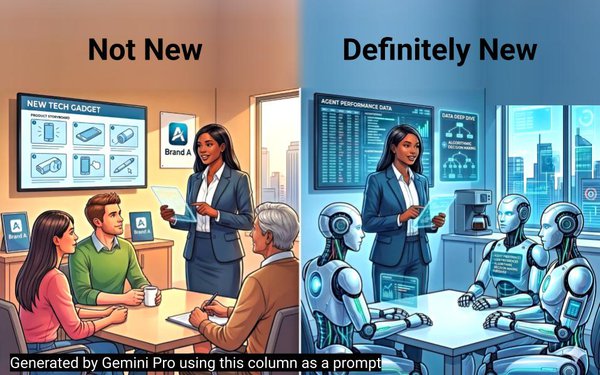
Perhaps the most
interesting thing about AI is that it is new yet nothing new.
AI is certainly new to marketing, and bringing all sorts of new challenges with it, although it may not be as big as
headlines would have us believe.
Last year, the CMO Survey of the American Marketing Association, conducted in partnership with Duke and
Deloitte, found a mere 17.2% of marketers reporting the use of AI to optimize or automate marketing.
Perhaps the percentage this year will be a step-change higher, but the self-estimated
three-year projection by marketers last year was only 44.2%.
Nonetheless, AI is breaking out all over. It is a new force to be reckoned with. But in many ways, AI is nothing but the
same reckoning as before.
advertisement
advertisement
Indeed, this is typical of marketing innovations. Almost always, they are nothing but new ways of solving the same old problems. Which is definitely the case with
AI.
Take search, for example.
Eight Oh Two, an SEO and PPC marketing agency, reported this year that 37% of brand-related searches now start with AI instead of a search engine.
This is a big shift, but it’s hardly anything new. There were headlines galore when Amazon became a viable competitor to Google for initial product searches.
The marketing issue then
and now was shifting strategy and investments to meet consumers where they live. AI will require change, but the challenge itself is nothing new. Brands just have to adjust accordingly again.
This is true of every change being wrought by AI right now. Recommendations, in particular.
A recent study by location marketing platform Uberall found that 83% of restaurants are
“invisible” to consumers in AI search because they don’t get mentioned when people ask AI for restaurants “nearby.”
But this, too, is nothing new. We
have known for a long time about the importance of showing up on the first page of Google search results. That’s where the eyeballs are.
So, getting there is the task of getting in front
of consumers. Broadly speaking, this is the necessity of getting into the consideration set, or at least the first step in doing so. That’s what SEO is all about.
For AI,
it’s called GEO. Which is just a new name for an old challenge. It’s about crafting content and brand information that will get picked up by LLMs. LLMs are different, but what they do and
the strategic challenge of influencing them is the same.
Influence is another thing about AI that is nothing new. Increasingly, people are relying on AI for product comparisons and
purchasing recommendations.
In this sense, AI is the influencer of demand. But influencing influencers is a long-standing task in marketing -- from children influencing mothers to friends
influencing friends to content creators influencing followers on social media.
Marketers have been at this for so long that they have gotten very good at influencing the influencers.
Marketers may need to go back to school on AI, but the basic idea is no different than before.
Much of this involves getting the attention of LLMs, and attention was the hot issue in
marketing immediately before AI appeared on the scene.
In fact, attention is an issue as old as marketing itself and was the reason why the Advertising Research Foundation developed the
original inverted pyramid back in 1961.
That funnel was not a purchase funnel, but a funnel for media-buying that began with the necessity of getting attention. All AI is doing is forcing
marketers to solve the same old problem again. The answer will be different, but the issue is the same as always.
Marketers are also concerned that AI only cares about facts, not
emotions, and that AI will operate independently of efforts by brands to enforce consistency of messaging with consumers. But these, too, are not new concerns.
It was concern about
consistency that kept the Coca-Cola Company from using its flagship brand name with its first diet cola, thus naming it Tab instead.
It was a concern when Larry Light introduced the idea of
brand journalism using many individual stories to deliver McDonald’s “I’m Likin’ It” campaign.
It has been an ongoing concern as media have proliferated and
fragmented. It is certainly an issue in managing the modern-day army of independent influencers that brands are using as gateways to consumers.
So, there is nothing new about this
concern when it comes to AI. Brands will have to manage consistency differently for AI, but the issue of consistency is an age-old challenge in marketing.
In these ways and others,
AI is not new at all. Yet, there is one thing about AI that is very different and new. In years past, humans have been the audience for awareness, attention, recommendations, consideration, influence
and consistency. That’s true for AI right now, but this is sure to change.
The way I’ve described it before is to say that marketers will have to learn how to
“advertise to algorithms.” Which is to say that AI is going to transform shoppers into agents as consumers delegate shopping and buying. Hence, much of the marketplace ahead will be
AI-to-AI.
Everything about marketing in the past has been designed for human audiences. Every theoretical concept, every practical application, everything has been about
persuading humans.
So far, AI is just another tool for persuading humans, and thus the same challenges as ever. But when consumers hand off shopping and buying to AI agents, humans will be
completely out of the loop.
This is not an issue that marketers have had to face before. Humans have always been the target.
But algorithms or AI itself will soon be the
target. That’s fundamentally new. All the other stuff is old wine in a new bottle. AI agents are a new vintage.
Until then, marketers would do well not to get ahead of
themselves or allow themselves to be intimidated by the changes at work with AI.
The nature of today’s challenges are identical to the challenges of the past. Marketers have successfully
met those challenges. There is no reason to suspect anything different now -- as long as it’s people at the receiving end.