Patriotism is alive and well in
America, with six in 10 participants in a recent survey saying they feel a strong sense of pride in being American, while only 16% feel little or none.
Although there is no real consensus on
the message that a brand celebrating America should lead with to connect with consumers, 20% in the survey cited history and heritage, while 19% cited people and communities and 16% cited diversity
and values.
Whatever version of America a brand chooses, the country’s people and stories reverberate best.
The political lens found that 24% of Democrats are more than twice as
likely to choose a message of diversity, while Republicans favor history and heritage, at 26% vs. 18%, respectively.
Brands reaching out to consumers with a patriotic ad or marketing message
may want to think about age. Data from a survey of 2,000 Americans fielded in June 2026 and conducted by Zappi, a consumer insights platform, reveals the nuances in linking brands
with national pride.
advertisement
advertisement
Robert Passikoff, founder and president of Brand Keys, made a point in the the brand and research consultancy's latest study that is reflected
separately in Zappi's findings.
He wrote: "patriotism is less about waving the flag and more about embodying values consumers associate with American identity," citing Brand Keys'
study Most Patriotic Brands.
Passikoff said the key is creating an emotional attachment, and that too
often patriotism is treated as a marketing tactic rather than a brand value that can in some cases tie to consumers' pride in a brand and country.
Data in Zappi's
study found that "very strong pride" nearly doubles between the youngest and oldest adults, from 29% of 18- to-25-year-olds to 56% for those
55 and up.
The intensity of patriotic pride shifts across generations, shaping how each person responds to patriotic advertising and marketing.
While the data found that younger
Americans warm to patriotic branding less than older ones, every generation views it favorably, but the level of enthusiasm varies.
Fifty-one percent in the study by Zappi cited July 4 as
America’s strongest symbol of national pride, followed by 46% who cited veterans and military service, 31% who cite local community celebration, 28% citing historical milestones such as
America’s 250, with Team USA in international competition cited by 26%, and 25% citing American innovation and business.
Sixty-three percent of those participating in the survey said
they trust a company more when it invests in jobs at home than when it runs patriotic ads, and 60% say brands celebrating people and communities feel more genuine than those that lean on national
symbols.
The percentage climbs with age. The study found that older Americans are more likely than the youngest group to strongly agree that investing in jobs builds trust, at 45% vs. 31%,
respectively.
Overall, the study found that patriotism is something consumers expect brands to demonstrate, not advertise.
When Zappi's survey asked Americans to name the brands that
most represent the country today, auto, heartland and heritage names
dominated.
Ford led by a wide margin, with 11% of all mentions, followed by Nike with 7%, and Coca-Cola at 6%, while
the tech giants were barely mentioned.
"A nostalgic image of the country" is what these brands have in common.
Fifty-six percent agree that patriotic symbols like flags have
become a political symbol, while 23% disagree, with these symbols now carrying political associations they did not have in the past.
Symbols matter when brands use them, perhaps more
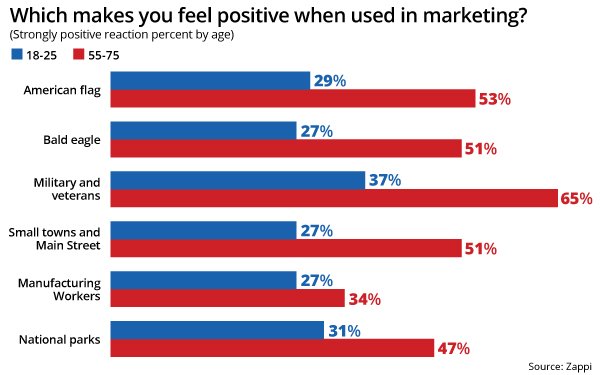
than many think. Older Americans react more positively to each, and the survey found that the human, everyday images resonate most, rather than the official icons.
In an analysis of positive
reactions versus negative in official icons, more than 25% see small towns and Main Street as positive and 25% view national parks as positive, and 21% see manufacturing workers as positive,
while all outscore the flag and the Bald Eagle.
Survey participants were asked how they felt each time a brand tied to a patriotic theme and how it affects the way the consumer views that
brand.
Some 34% overall said this had a positive impact, while 49% said it made them view the brand more positively, and 16% said it made them view the brand more negatively.
“Made in America" carries value, according to the survey, with 64% saying they would pay more for an item designated as such, and 29% saying they would pay significantly more, and 22% saying
they would take the less expensive option regardless of where it was made.
Among those who were willing to pay more, 80% of Republicans said they would pay more -- as much as 40% more --
whereas 61% of Democrats said they would pay more. The study also found that 27% of Democrats would take the cheaper option, vs. 14% of Republicans.