Legacy cybersecurity with
isolated alerts can lead to critical gaps in visibility for agentic and AI systems, but the next generation of cybersecurity must pivot toward continuous contextual synthesis and proactive containment
that can reason and make decisions on its own.
Microsoft on Monday introduced "Project Perception,” its vision for the future of new agentic cybersecurity system that is designed to turn
“signals into real-time protections using AI to defend against AI." It enters public preview on August 3.
advertisement
advertisement
This multimodel approach offers advanced software vulnerability management based
on industry benchmarks to enhance security across digital environments, and continually learns from combining signals, context, models and specialized agents.
Media buying now relies
heavily on automated "agentic" software such as automated bidding systems and programmatic algorithms.
These systems face vulnerabilities from weaponized AI and cybersecurity systems.
The shift to autonomous, agentic cybersecurity directly impacts processes by securing programmatic ad-supply chains, protecting automated ad-buying algorithms and reducing financial
losses from AI-driven ad fraud.
Microsoft’s system can reason, prioritize and act at machine speed while giving humans complete control with new types of structured sequence of
steps or tasks performed to achieve a specific outcome.
The architecture combines frontier and specialized cyber models, optimizing for quality and cost. It is based on a simple idea -- the
ability to think and understand how a cyber-attacker sees the world, how a defender evaluates risk and how protections are improved over time.
The system coordinates three types of agents, and
together they form a closed-loop system that continuously discovers, evaluates and improves an organization’s security posture.
Red agents identify potential paths to
compromise before an attacker can exploit them.
Blue agents investigate, reason over context and determine what represents meaningful risk. Green agents take corrective
actions and strengthen defenses across the environment.
The news comes as Nvidia launched an open-source alliance with a host of tech giants today.
The AI safety initiative focuses on
open models, as the fallout from a cyberattack committed by rogue OpenAI models on Hugging Face continues.
Other members of the alliance, which is quite extensive, includes
DoorDash, Capital One, Cisco, Dell, SpaceX, Palantir, Microsoft and dozens of other tech companies from the U.S. and Europe. Noticeably missing from the list in Nvidia's blog,
Google, and Meta.
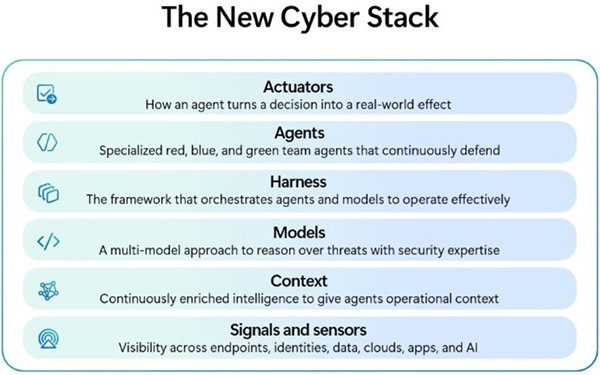
Cybersecurity for the AI and agentic era involves more than adding agents. It requires a new Cyber Stack, designed from the ground up.
Microsoft explained how its
cyber stack begins with signals and sensors to provide awareness across the entire digital business.
Models provide intelligence and reasoning, and a harness coordinates models and agents
across security workflows.
Agents apply that intelligence across security workflows, while actuators translate decisions into protection. These combined layers create a continuous learning
system that can understand risk, adapt to changing conditions and improve security.
The correct model is determined by the combination of quality, reliability, latency and cost.
This approach is shaped by ongoing research, benchmarking and evaluation across frontier and specialized models.
Microsoft's security researchers continuously assess models against
real-world security challenges, enabling its team to match each task with the model that delivers the best outcome. This allows customers to benefit from advances in AI without being tied to any
single model.