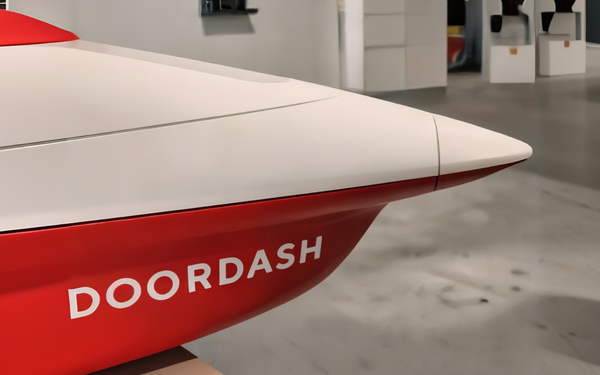
DoorDash is creating a different type of retail media
network (RMN) -- one that could enable media buyers to purchase ad placements across a variety of media not yet explored.
The company received Federal Aviation Administration (FAA) Part 135
air carrier certification that will allow it to launch DoorDash Air, an in-house drone service developed by its robotics division, DoorDash Labs.
“I believe
it’s the next frontier of delivery, and what we’ve learned after years of progress is that you have to solve the full end-to-end system to find out what works and what scales with your
customer,” DoorDash co-founder Stanley Tang wrote online.
Tang worked at Facebook as a software engineer in 2012 before co-founding DoorDash.
Alongside operating the service,
DoorDash also is developing an aircraft for local deliveries. The move shifts DoorDash from a marketplace to an operator that can offer all types of opportunities for brands.
advertisement
advertisement
This is part of a strategy to expand its services after DoorDash co-founder and CTO Andy Fang earlier this month unveiled "dd-cli," a command-line tool in an
invite-only limited beta that allow developers to build AI agents that search stores, build carts and place food orders directly from the terminal.
As agentic and artificial intelligence
continues to accelerate a shift toward personalized conversational commerce, DoorDash designed the tool for macOS users in the U.S. and Canada. It also supports integration with AI tools like
Claude Code and Cursor.
The AI agents can autonomously search restaurants, compare deals, and complete checkout on DoorDash without manual input from a human, and then process the
payments.
"We see agentic commerce reinforcing the importance of building a seamless end-to-end shopping experience," Mike Goldblatt, vice president at DoorDash, told MediaPost in an
email. "AI can help consumers discover what they need, but successful commerce still depends on accurate inventory, reliable fulfillment, and local selection. Our focus is on building that
foundation."
Without opening the DoorDash app, the dd-cli tool connects directly to the company's ordering
infrastructure in the agentic command line of the code. It can integrate into a productivity tool such as a calendar assistant, for example, that could trigger a food order as part of the task.
The move comes as DoorDash integrates with Shopify, a cloud-based commerce platform.
DoorDash began integrating with restaurants, but today it is helping
consumers access everything from groceries and convenience items to beauty products, apparel, sporting goods, home improvement supplies, and more, Goldblatt said.
In Q1 2026, DoorDash fulfilled tens of millions of grocery and retail deliveries in less than 30 minutes across more than 22,000 ZIP codes, and as of December 2025, more than 30% of its monthly
active users in the U.S. were already shopping across retail and grocery categories.
"We see a significant opportunity ahead as consumer expectations continue to evolve," he said. "That's why
we've spent the last several years expanding selection, strengthening our retail partnerships, and investing in better inventory quality, fulfillment capabilities, and merchant tools."
DoorDash in 2025 became the leading third-party marketplace by order volume across grocery and retail in the U.S., according to YipitData, a third-party research firm.
Changes to the platform have become an opportunity
for media buyers to expand through DoorDash’s retail media network. This means more local merchants and categories are now available on the platform to reach
shoppers at that moment consumers are close to making a purchase.
In the future, DoorDash plans to focus on
making local commerce more accessible for merchants.
The Shopify integration is one example of that approach, helping independent retailers reach its customers with minimal operational
challenges and making DoorDash available as a native sales channel directly in the platform.
For eligible Shopify merchants with a brick-and-mortar presence, activating DoorDash no longer requires a separate onboarding process, manual catalog uploads, or managing inventory across multiple systems. Merchants can enable DoorDash directly from Shopify, while product catalogs and inventory become synchronized automatically.
As retail categories continue to expand on DoorDash, Goldblatt said the company will create new opportunities around product discovery, local demand generation, and cross-category shopping behavior.
"We've seen strong
merchant interest so far, onboarding more than 150 merchants through the Shopify integration during the pilot phase," he said.