Digital advertising has lost the click-through,
putting its future into serious question by forcing a painful reinvention of how digital is valued, bought and measured.
Zero-click searches and the complete decoupling of information from
website visits, redistributing them to AI tools like chatbots or answer engines, are at fault for disrupting the ecosystem.
If Google AI Overviews or OpenAI ChatGPT absorb 40% of web
traffic, but only redirect a mere 4% back to publishers as OneLittleWeb’s recent data suggests, it cements the idea that search engines have transformed from gateways to destinations.
The gap between the 40% loss and the 4% gain represents evaporating user engagement with publisher and independent websites. It’s a new reality, but an evolution of an old concept.
This "lost" traffic is not being redirected to other sites. It is being permanently held by the AI interface, whether that is Google AI Overviews, OpenAI ChatGPT, Microsoft Copilot or others.
advertisement
advertisement
Most websites rely on ad impressions and affiliate clicks to survive, but that revenue is slowly being taken by chatbots and other AI tools. The 9,531 AI tools analyzed in OneLittleWeb’s
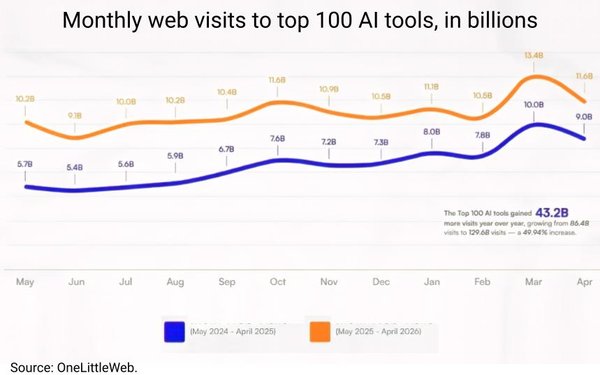
study generated 144.5 billion web visits during the past 12 months, up 40.12% year-over-year.
The top 100 AI tools alone accounted for 129.6 billion visits, grew 49.94%, and held an 89.69%
market share of all AI tool web visits that OneLittleWeb tracked. This means nearly nine out of every 10 visits went to just 100 platforms.
Analysts at OneLittleWeb analyzed more than 170
categories using data from its AI tools dashboard. Combining monthly web visit estimates from Semrush and Ahrefs, the analysts examined 24 months of traffic data from May 2024 to April 2026 and
compared the last 12 months with the previous year.
OneLittleWeb tracks 10,173 major websites across every industry, including the AI tools in this study.
Combined, those websites
generated 3.44 trillion visits during the same period. AI tools accounted for 144.5 billion, or 4.20% of all tracked web traffic -- not that much when taking all numbers into consideration.
New YouGov BrandIndex data released Thursday found ChatGPT is the most preferred AI tool among U.S. generative AI users, while Gemini has posted the biggest increase in preference.
Among
U.S. adults who have used generative AI in the past 30 days, 33.7% say ChatGPT is the AI tool they prefer using most, and Gemini ranks second at 18.2%, followed by Microsoft Copilot (8.2%),
Apple’s Siri (7.7%) and Anthropic’s Claude (6.1%), according to YouGov.
Gemini’s preference score rose 6.8 percentage points between February and July 2026 -- the largest
gain among eligible AI brands.
Copilot rose by 3.0 points and Claude gained 0.8 points, according to the YouGov study.
YouGov’s numbers match OneLittleWeb’s analysis that
tracked ChatGPT as generating 64.7 billion web visits between February and July 2026.
OneLittleWeb data also showed that ChatGPT represents 44.76% of the entire AI tools market and 49.92% of
traffic within the top 100.
Canva ranked second with 10.5 billion visits, according to OneLittleWeb data, leaving ChatGPT with more than six times the traffic of its closest competitor in the
overall ranking.
It’s not difficult to imagine that ChatGPT added 26.6 billion web visits -- more than any other tool -- because OneLittleWeb data shows its traffic increasing 69.80%
year-over-year.
Gemini recorded the second-largest gain -- adding 5.6 billion visits and growing to 450.33%. Claude added 2.4 billion visits -- up 250.07% -- and Grok grew 731.26% to reach 2.5
billion visits.
It’s not surprising that AI continues to quickly expand and become concentrated around a small group of leaders, but it still represents a small share of total
activity.
The chatbot category grew from 45.1 billion to 86.0 billion visits, up 90.82%. It took 59.52% of market share.
Translators like Google Translate moved in the opposite
direction -- losing 1.6 billion visits, or 22.52% -- as user attention continued to focus around general-purpose conversational platforms. This is likely attributable to chatbot users using the tool
to translate words and phrases.
This is not a U.S. phenomena. Singapore ranked first with 16.1 million AI web visits per 100,000 people, although it has a population of only 5.9 million.
The Netherlands followed with 9.8 million visits per 100,000 people, ahead of the U.S. at 8.4 million, while the U.S. still generated the highest overall volume at 29.2 billion visits.