Prime-Time Upfront Ad Sales Rise 9% To $33.7B, CPMs Fall 6%


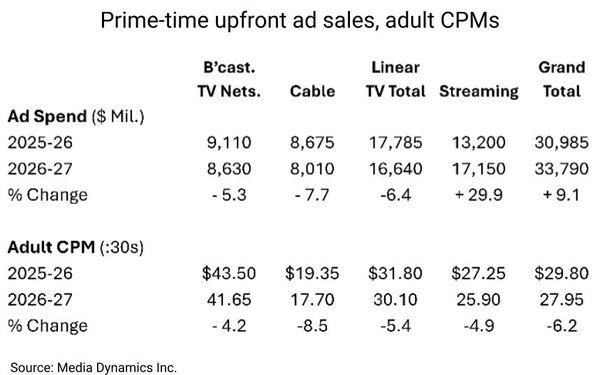
Total TV upfront ad sales activity for the upcoming 2026-27 TV season was up 9% to $33.7 billion -- largely attributable to a major increase in streaming upfront deals, according to Media Dynamics estimates.

Streaming soared 30% to $17.2 billion from the year before, with cable sinking 7% to $8.0 billion and broadcast TV networks slipping 5% to $8.6 billion.

“The shift from linear to streaming has accelerated and... cable is taking the largest hits, partly due to its reduced sports presence compared to broadcast TV,” says Ed Papazian, president of Media Dynamics.

At the same time, he estimates CPMs -- the cost per thousand viewers -- are down across the board, including CPMs on streaming TV platforms.

“Buyers are being very tough [regarding] CPMs, including streaming where FASTs [Free Ad-Supported Streaming Television] present a low CPM option relative to premium sellers like Netflix,” says Papazian.

advertisement

advertisement

“So more money is being spent in streaming -- but the buyers are seeing to it that they pay less per viewer.”

He estimates broadcast TV networks have seen a 4% decline to $41.65 (from $43.50), with cable sinking 8.5% to $17.70 (from $19.35) and streaming losing 5% to $25.90 (from $27.75).

The upfront advertising marketplace is when major brands typically buy 60% to 70% of their TV and streaming inventory needs in the summer ahead of the upcoming fall start of TV season, which ran from September to August of the following year.

4 comments about "Prime-Time Upfront Ad Sales Rise 9% To $33.7B, CPMs Fall 6%".
Check to receive email when comments are posted.
  1. Ed Papazian from Media Dynamics Inc, August 11, 2026 at 5:29 p.m.

    Wayne it's interesting to note how important to streaming those national TV ad dollars are. In addition to the $17 billion in upfront buys other negotiations ,which may shift some linear TV scatter dollars to streaming, might amount to another $3-4 billion throughout the upcoming season. If so, that means that this type of advertising will amount to, say $20 billion. Since You Tube garners about $10 billion under its way of capturing screening ad revenues, this leaves very little for those supposedly super targeted "outcome" based streaming campaigns that we hear so much about from the theorists at the various industry gatherings.

    The question is will traditional TV advertisers simply swamp streaming with their ad dollars to the point where take it over and use it as they have always used TV or will there be some sort of push back to prevent this from happening--as it did, largely, to cable. Will streaming become mostly an untargeted eyeball aggregator--based on 18-49 time buying with lower CPMs the primay goal and upfront buys the mechanism for attaining that--or will some of the promises bear fruit in a big way--to the possible benefit of advertisers, screening services and consumers.

  2. Joshua Chasin from KnotSimpler, August 12, 2026 at 4:25 p.m.

    So Ed: if revenues are up but CPMs are down, one of two things must be happening: either a higher % of inventory was sold in the upfront than in the past; or, there must be more inventory (you can't raise total revenues and lower unit costs without one of these things happening.)

    Which is it? I'm guessing the latter (more streming inventory, same linear inventory.)

  3. Ed Papazian from Media Dynamics Inc, August 13, 2026 at 12:25 p.m.

    Josh, I'm speculating, but the number of sellers and the etent of their GRP inventory are not fixed at the same level year to year. Remember that, unline linear TV, streaming viewing as well as the amount of time that is ad-supported are incresing. So it's perfectly possble that more GRPs wre available in aggregate-- and this allows for greater ad spend but lower CPMs.

  4. Ed Papazian from Media Dynamics Inc, August 13, 2026 at 12:31 p.m.

    Sorry about those typos--I responded in haste. 

Next story loading loading..