The single, holiday
shopping weekend is officially over for Black Friday and Cyber Monday, as consumers become more calculated in their purchases by hunting for deals in months-long approaches.
Shifts
in consumer behavior are pushing advertisers to track shopping preferences more closely and launch holiday campaigns earlier, as shoppers can more easily compare products and become familiar with
brands.
The findings come from tvScientific by Pinterest, the performance connected TV (CTV) advertising platform. It recently released 2026 Holiday & Seasonal Shopping Trends Report,
based on surveys of 487 U.S. marketers and 600 consumers, examines how people shop across holidays and retail moments throughout the year.
This year, the report goes beyond marketers’
plans and pairs the findings with consumer behavior to show how consumers discover, evaluate, and buy across screens during the year's shopping moments.
advertisement
advertisement
What emerges is a clear picture of what
it takes to engage with consumers and in what media advertisers will invest.
The data suggests that social will receive the biggest share of the budget at 68%, followed by 54% going to
performance TV and connected TV, 44% to online video, 32% to influencer and creative marketing, 23% to search, 16% to audio and podcasts, 14% to email and CRM, 14% to display, and 3% to print and
out-of-home.
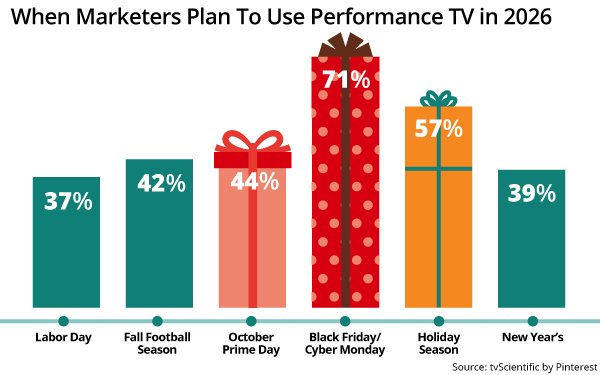
The data also shows 62% of marketers plan to launch holiday campaigns earlier because of increased pressure to prove revenue and return on investments (ROAS).
"The
assumption behind shorter campaigns is that the purchase decision happens right before checkout," Jason Fairchild, tvScientific CEO and co-founder, told MediaPost. Pinterest also added general manager
of programmatic and affiliate last week to his list of titles. "Holiday shopping doesn't work that way anymore. It's a longer, multi-session journey."
Fairchild said the research found only
15% of consumers wait until Black Friday or Cyber Monday to begin buying gifts. One-third begin researching before October, and many make purchase decisions weeks before the biggest promotional
events.
The objective is not to make campaigns longer for the sake of it or to simply spend more -- but instead to align investment with as consumers form preferences.
Pinterest sees
more than 80 billion searches a month, and 96% of text-based searches are unbranded, which means people are still exploring and forming preferences.
The length at which campaigns run will
vary by brand and category, but Fairchild expects many marketers will shift budget into earlier seasonal moments like Labor Day, October Prime Day and fall football rather than simply extending
campaigns.
Reaching consumers earlier can be more efficient because brands are influencing consideration before media costs and competitive pressure peak later in the season. Over half of
searches on Pinterest are commercial, so brands have an opportunity to show up with genuinely relevant, helpful content while decisions are still being formed.
Performance expectations for
television also has changed. Fairchild said a few years ago, connected TV was primarily viewed as an awareness channel, but now marketers expect television to contribute measurable business
outcomes alongside search and social.
The research reflects that shift. Sales and revenue ranked well ahead of traditional awareness metrics as marketers' primary definition of success this
holiday season.
Performance TV allows brands to combine premium video environments with measurable outcomes like site visits, conversions and revenue. As holiday shopping expands across
multiple seasonal moments, marketers want channels that can influence consideration early while also proving what is driving sales.
AI is becoming part of the seasonal strategy, with 48% of
marketers using it most for creative ideas, 43% using it for audience targeting, and 39% for creative personalization.
"AI agents represent the next evolution, where the technology helps to
coordinate decisions across an entire campaign instead of solving one task at a time," Fairchild said. "That's especially valuable during the holiday season, when marketers are managing more
campaigns, more creative variations and more optimization decisions than at any other point in the year."
Fairchild believes AI agents will not replace marketers, but will help teams process
more signals, identify opportunities more rapidly and make smarter optimization decisions -- allowing marketers to focus on strategy, creativity and business outcomes rather than manual execution.