Commentary

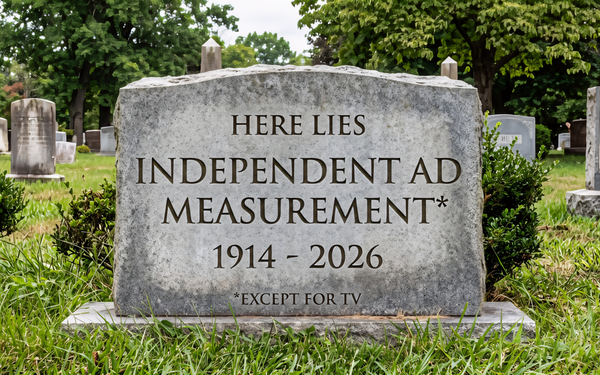
Independent Ad Measurement (Outside Of TV) Is Dead

Most in our industry should care about having independent, trusted third-party measurement anchoring the buying and selling of all advertising in the U.S.

First, the amount of money at stake is enormous; U.S. ad spend will approach half a trillion dollars this year.

Second, the societal impact of advertising is unmatched by any other industry. It not only funds virtually all our news, information and entertainment, but it is also designed to persuade us to believe, want and do things that we would not otherwise.

Finally, as an intangible asset class, advertising is extraordinarily vulnerable to adulteration, manipulation and misstatement — something actors in our industry (on both sides) are constantly culpable of.

We don’t stand for the widespread distribution of food, gasoline, housing or drugs without independent standards and measurement.

advertisement

advertisement

We should care as much for how Americans feed their minds, belief systems and emotions each day.

Unfortunately, most advertising transactions today are and will be bought and sold on self-reported numbers. Alphabet, Meta, Amazon, Microsoft and TikTok today represent 65% of all advertising bought and sold in the U.S., and all of them self-report that vast majority of their ad transactions.

And their collective share of the market is growing, as they rapidly expand into the TV and premium video ad market, a heretofore impregnable bastion, staunchly defended by legacy TV companies.

Except for what they are selling into dedicated linear TV ad budgets, they are living on their own numbers with only cosmetic veneers of verification. 

Given that they see themselves and operate as mass-reach direct-marketing companies, it’s easy for them to convince themselves that they don’t have to operate in an independently accountable advertising world.

TV advertising, of course, continues to stand separately.

Nielsen survived the onslaught of an “alt measurement movement” of would-be competitors. It fixed key vulnerabilities in its legacy approaches (even if some players aren’t happy) and renewed long-term contracts with its sell-side customers, continuing to be required currency on the vast, vast majority of national TV advertising campaigns.

Furthermore, by purchasing DoubleVerify, Nielsen enters the performance optimization market without having to directly play in media activation.

Hopefully, Nielsen will link all of the data that DoubleVerify tags can capture with its enormous top-of-the-funnel audience and publisher measurements, and the data from its TV viewing panel and Big Data platform.

Reach and frequency still matter, particularly if tied to deeper-funnel metrics.

Brands and retailers need to know how many, how often, when and who of their target customers they are reaching with their commercial communications.

They also will need more standardized and more accurate media mix and attribution models instead of the plethora of ones out there now heavily skewed to real-time and super short-term search, social and e-commerce impacts.

What do you think? Is there any independent ad measurement still alive outside of TV?

15 comments about "Independent Ad Measurement (Outside Of TV) Is Dead".
Check to receive email when comments are posted.
  1. Gordon Borrell from Borrell Associates, August 27, 2026 at 2:13 p.m.

    Yeah, I know of one company used by a range of advertisers, media, agengies, and trade associations to track both TV and the other 90% of ad spending, down to the county level and across 18 different types of media. And rhe data is now on steroids, behind an MCP server. Its why some of the biggest advertising media get bigger. They "see" where that other 90% is coming from.

  2. Ed Papazian from Media Dynamics Inc, August 27, 2026 at 2:25 p.m.

    Of course, Dave--for other forms of "legacy media"--radio, magazines, newspapers, etc.

    But you are right for  some of streaming and most of the rest--digital audio, social media, You Tube, etc. the sellers provide whatever data they can get away with.

    On the positive side, most of this problem affects non-branding campaigns. A typical branding ad budget consists of 50-65% linear TV plus streaming and about 10-15% in other traditional forms of media--leaving only 20-25% in question re measurement. In contrast, sales promotion buys are very heavily concentrated in digital media which do not provide third party measurement. For search, it may not matter as most search buys charge only for clickthroughs. But for the rest--LOL.

  3. Dave Morgan from Simulmedia replied, August 27, 2026 at 3:31 p.m.

    Gordon, exactly. Without market wide currency, the game moves to proprietary databases and arbitrage.

  4. Dave Morgan from Simulmedia replied, August 27, 2026 at 3:34 p.m.

    Good points Ed, but the digital platforms claim (and charge for) branding value in their banners, newsfeed mentions, web video, social video, audio, podcasts and search. The spend their massively outweighs everything else now.

  5. Ed Papazian from Media Dynamics Inc, August 27, 2026 at 4:11 p.m.

    That may be, Dave, but such branding "enhancements" are primarily oriented to appeal to sales promotional people for their campaigns, not the brand managers and CMOs who direct the marketers' major branding efforts. In other words, "advertising" has a split personality. The branding side is usually handled by different people --and agencies--than the sales promo function and the latter is increasingly in-house. The objectives are different as are the metrics and thus the need for better auduence measurement. It's far more important for the branding side.

  6. Lubin Bisson from Qzedia Media Inc, August 27, 2026 at 4:27 p.m.

    Extraordinarily vulnerable, Dave.  100% agree.

  7. Howard Shimmel from Janus Strategy & Insights, LLC, August 27, 2026 at 5:02 p.m.

    Dave, agree 100%. I grew up in a fairly open and transparent Linear TV marketplace. We knew our share of viewing, we knew what advertisers ran on competitive networks and not ours. Got to AOL in 2001 and it was so different. So opaque. I had no idea what AOL's share of consumption was. Fast forward 25 years, and things are so much worse. There's not enough discussion about how we operate as an industry without a comprehensive, marketplace view of consumption, ads, spend. There's definitely not enough talk in the industry about this. 

  8. Dave Morgan from Simulmedia replied, August 28, 2026 at 6:18 a.m.

    Howard, yes. It starts with no transparency into overall consumption, nor a desire on the part of he digital walled gardens to proved one at the campaign level

  9. Frank Zazza from iPause Ads, August 28, 2026 at 9:51 a.m.

    Dave, I agree. The comments also show that advertising has two different measurement needs. Brand advertising still requires trusted, independent measures of reach, frequency, and audience delivery, while performance marketing can be held accountable through verified consumer outcomes.

    Outcome-based advertising will not replace a market-wide measurement currency, but it can reduce dependence on self-reported platform metrics. When payment is tied to a clearly defined and independently auditable action, such as a qualified visit, lead, or purchase. The advertiser can verify what occurred and pay for performance rather than a platform’s estimate of exposure.

    Gordon is right about the danger of proprietary databases and arbitrage, Ed is right that branding and sales promotion require different metrics, and Howard is right that the overall marketplace has become far too opaque. The strongest path forward may be a combination: independent audience measurement for branding, transparent outcome verification for performance, and common standards that prevent the seller from being the only party grading the results.

  10. Dave Morgan from Simulmedia replied, August 28, 2026 at 10:18 a.m.

    Thank you Frank. Really great framing of the two sides of the ad measurement problem and synthesis of potential ways to solve them. In my view, Ed is absolutely correct that the branding and promotion side will require different metrics as iw Howard on the criticality of overall market transparency, particularly around share of viewing -- a reason that I have been a fan of Nielsen's Guage and its potential to be expanded to other media channels and to deliver granular audience cuts as well.

  11. Bryon Schafer from Highline Strategy Group, August 29, 2026 at 2:07 a.m.

    Dave, independent measurement survives outside television, but mostly in legacy media and limited forms of digital verification. The harder question is how independent a measurement system can be when the companies being measured are also its largest funders. At Hulu, we pushed for Nielsen to measure impression-based, on-demand video on its own terms, while many companies had strong incentives to preserve the existing currency. The resulting gap was filled by platform self-reporting, which was a worse outcome.

  12. Dave Morgan from Simulmedia replied, August 29, 2026 at 7:57 a.m.

    Bryon, yes. You hit on the key point. There is little "indepdendence" when the companies being measured, particularly in more custom ways, are also largest funders of that measurment. It has been decades since those who buy advertising have also shown a willingness to take responsibility for making sure that there is true independence in its measurement, even if it means helping pay for that measurement system.

  13. Ed Papazian from Media Dynamics Inc, August 29, 2026 at 9:04 a.m.

    Guys, just to be clear, I don't think that anyone has seriously  accused Nielsen, MRI or, previously, Arbitron for radio, of cooking the numbers to falsly inflate them. Instead, the pressure by the media sellers is mostly applied on the methodology side as it is known that certain types of measurements produce bigger--or smaller--- numbers for ealmost everyone. So those that generate bigger numbers are supported; the others are not. 

    In addition, the media sellers often influence the kinds of data that are made readily available. Hence, in TV and radio, most reports do not show the findings by income or education as some sellers would not fare as well on such metrics. The data is available--but you must be a subscriber to dig it out. 

  14. Dave Morgan from Simulmedia replied, August 29, 2026 at 10:18 a.m.

    Ed, by no means am I suggesting that Nielsen, MRI, Arbitrton are cooking numbers and being paid. If you read Bryon and my comments, it is the opporssite. Digital ad verification and "proof" companies have significant intermingled economics with the owners and sellers of that inventory, which is why most of them make the majority of the economics selling optimization, not verification. Legacy media measurement companies may not make everyone happy, but their operations and economic interests are very transparent.

  15. Ed Papazian from Media Dynamics Inc, August 29, 2026 at 10:45 a.m.

    Dave, that's true about the "transparancy" in traditional media audience surveys. However there is a difference when it comes to TV, it seems. For example, when DVRs appeared it was feared by the sellers that Nielsen's "live" ratings would decline due to delayed viewing. Meanwhile the buyers were pushing for the reporting to switch to commercial minutes from all-content minutes. So both sides cut a deal and got Nielsen to switch to C-3 reporting, while at the same time shitfing to commercial minute ratings. Result: the ratings didn't change and nobody's boat was rocked. 

    More recently Nielsen has changed its definition of what constitues a quarter rating for local radio and TV. The result is  significantly higher quarter hour ratings for the stations to use as "currency" --even though many of the people counted as "reached" will have tuned out--or to other stations--- and can't watch the advertiser's commercial. Are the time buyers up in arms over this? Nope. Not a peep. In my days at BBDO, we and the other agencies would not have allowed this kind of manipulation. 

    So what we are getting is increasing seller control of TV and now radio  data  repotring, with the buyers going along with it as an accomodation with the sellers. Sure, the buyers can make correctivve "adjustments" in the data--but how many  bother ---or know how to do it?

Next story loading loading..