Many agencies do not see the performance expected from
ChatGPT Ads campaigns, despite OpenAI touting improved testing to target audiences.
Peter Jaffray, managing director and privacy officer at Choice OMG, a Canadian digital marketing agency
based in Edmonton, Canada, told MediaPost he ran a small campaign targeting ads in Ontario and Alberta, but didn’t get any interested buyers, zero, though they were inexpensive and real.
“Ads only reach free ChatGPT users,” he said, explaining that he invested $415 to run three campaigns.
He expected about four-thousand targeted impressions from the ads that ran
for two weeks, but he got nearly nine-thousands.
“I got many more impressions than expected, but the clickthrough rate was substantially lower, about 0.6%,” he said.
“Generally, I would get 2%, if I compared the campaign with search ads, rather than display.”
advertisement
advertisement
Jaffray received 60 clicks from the ad campaign, which he estimates cost him about $7
per click. The clicks originated from real people, he believes, but none of the ads were targeted. Those clicking on the ads didn’t engage with content on website after they landed on the
site.
“The IP addresses were legitimate, but none of the people seemed interested enough to make a purchase,” he said.
Jaffray’s campaign ran in June. He thinks
OpenAI’s targeting ability hadn’t reached a point where the ads could really target those interested in converting from lookers to buyers, but they did not.
“When we ran the
campaign, it seemed more of a display channel, than an engaged channel,” Jaffray said.
A quick search on ChatGPT identified that OpenAI didn’t begin offering geotargeting and
custom audience ad options from its platform until August 2026. That’s when ChatGPT parent company introduced conversion optimization, OpenAI Pixel Conversions API, and third-party
measurements.
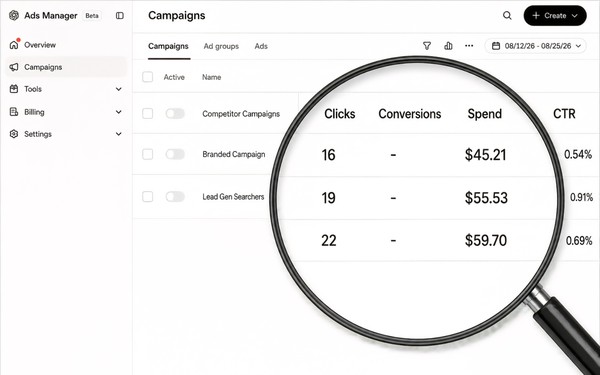
Nicholas Verity, CEO at Cleverly, a B2B lead generation agency, tested ChatGPT Ads recently, but had to quickly pause the campaign. Like Jaffray, Verity's campaign received
"descent" CTRs, but zero conversions.
Verity ran the same campaign on other platforms, and the CTRs on ChatGPT were lower than what the campaigns received from Google and Meta.
OpenAI reported 57 clicks, and Google Analytics reported less than 20 visits from the same campaign. He added Urchin Tracking Modules (UTMs). a snippet of code, to track the
performance across different traffic sources.
The numbers didn't match reality, he wrote in a LinkedIn post, "so if the platform's own numbers don't match reality, either
the metrics are unreliable or it is double-counting clicks from the same user. We can't justify testing more spend on top of it."
The part that kept his interest, Verity
believes OpenAI has the search intent and volume to become a massive ad channel long-term.
"I'd expect their platform and measurement to improve a lot over the next 6 months," he
wrote.
The sentiment echoed throughout the comments to Verity’s LinkedIn’s post.
Daniel Johnson, We Scale Startups founder, wrote in LinkedIn that he experienced the
same after testing ChatGPT ads for a couple of clients.
“The click count never quite lined up with [Google Analytics], and not always in the same direction,” he wrote. “Until
the platform's own reporting is trustworthy, I'd treat any spend there as a research budget, not a channel you're scaling.”
Ryan Edwards, co-founder of Camino5, an SEO and AI search
strategy agency, called what Verity described as a common problem.
Edwards explained in the comments of Verity’s LinkedIn post hearing about a campaign that ran where someone invested
around $1,000 testing ChatGPT Ads and got clicks, but no data appeared in Google Analytics.