Major cyclical events continue to drive strong ad
growth during the first half of 2026. Macroeconomic concerns have eased amid a resilient consumer market that shows optimism, playing a major role in the change.
The Interactive Advertising
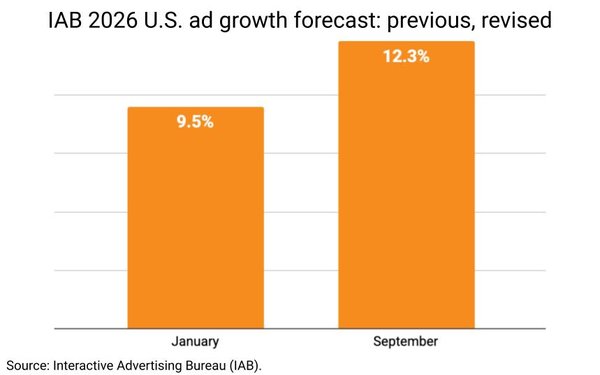
Bureau (IAB) has released an updated U.S. ad-spending forecast -- up 2.8 points to more than 12.3% for 2026 compared with its estimates in January 2026.
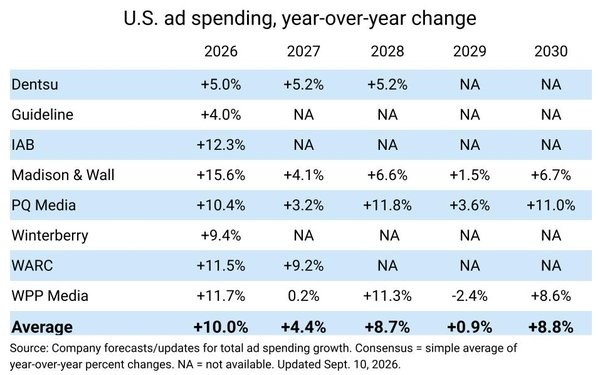
Based on the IAB revision, as well as Wednesday's update by Madison and Wall, MediaPost's ad forecasting composite
moves two points to a 10.0% rate of growth for 2026 from 8.0% prior to this week
(see composite below).
advertisement
advertisement
“The first half was strong, major live events delivered, and advertisers have increasingly powerful tools in their arsenal to find and engage customers,”
stated David Cohen, CEO, IAB. “At the same time, the economy has real areas of uncertainty. There is growth to be found, but there are no easy wins.”
The updated outlook shows
a clear shift in what advertisers want their media investments to accomplish. Customer acquisition -- although usually the top media investment goal -- jumped nine percentage points to 63% since
January, while brand equity rose six points to 43%.
Repeat purchases held essentially flat at 24%, after nearly doubling as a priority since 2024.
The Winter Olympics and World Cup set
audience and ad revenue records this year, which helped drive stronger than-expected ad spend in the first half of this year.
“Buyer sentiment appears bullish regarding the upcoming
midterm elections rounding out a busy, event-driven year,” according to the report, 2026 Outlook Study: September Update. The report’s title outlines a snapshot of U.S. ad spend,
opportunities, and strategies for growth.
Buyers are less concerned than they were in January about macroeconomic headwinds affecting ad investment, while AI-driven search, low-quality AI
content, and agentic buying remain key concerns. These headwinds are economic conditions or trends that slow down growth, reduce corporate profits, or make financial progress more difficult for
businesses and consumers.
Adapting to changing consumer behavior, including AI-driven search, remained media buyers’ top investment challenge in September 2026, cited by 44% — the
same leading concern identified in January.
Adapting to AI-driven search reinforces buyers’ renewed focus on acquisition and brand-building, as they look to capture consumers within
evolving purchase journeys. Some buyers are concerned about low-quality AI-driven content by small and medium-size businesses.
Keeping pace with evolving consumer behavior remains a top
challenge as consumers turn to AI for product discovery, evaluation, and purchase. Low-quality AI content, known as AI slop, compounds uncertainty, particularly for SMBs.
At the same time,
optimizing content for AI-generated answers is now the top area of increased focus among buyers at 76%, followed by AI large language models (LLM) at 72%. Focus on generative AI use in media campaigns
stands at 69%, compared with 78% in January.
Though still high, concern around understanding agentic and generative AI has settled after January’s peak. Headwinds and media inflation
have also softened as this year’s major sporting events delivered for buyers, according to the IAB.
Nearly nine in ten buyers are adapting their measurement approaches to AI-driven web
consumption, but the transition remains difficult. For many advertisers, comparing AI-driven and traditional consumer journeys is still their top measurement challenge.
Digital channels
continue to drive the expanding ad market. Social media is projected to grow 16.5%, up from 14.6% in January.
IAB estimates connected TV (CTV) will grow to 15.6% from 14.6% in January;
commerce media to 13.6% from 12.1; and podcasts to 8.7% from 8.6%, respectively.
Digital video excluding CTV is one of the few media that will decline to 9.4% in September from 9.6% in
January. Paid search is expected to decline to 8.1% from 8.2%, digital out of home is expected to decline to 7.0% from 7.4%, and linear TV will fall to 1.5% from 1.7%.