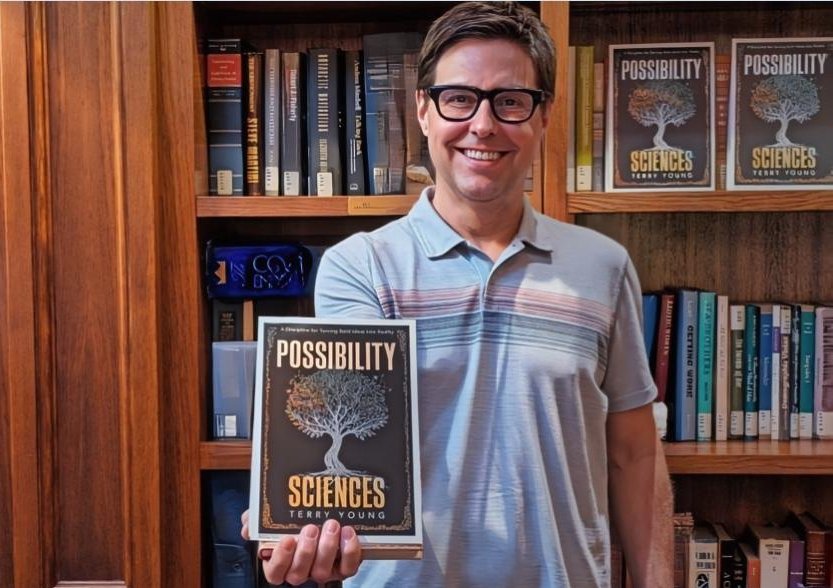
It has been nearly two years since Omnicom shuttered innovative cultural intelligence consultancy Sparks & Honey
and Founder Terry Young began working on a secret venture to "democratize moonshots and rebuild the infrastructure of innovation." Now he is coming out of stealth mode.
Young, who previously
proved what's possible by organizing the elements of culture in a scientific way, is now taking on an even bigger and far more encompassing endeavor: the science of possibility itself.
The
multi-pronged effort begins with a new, aptly named book -- "Possibility Sciences" -- which functions as an operating manual for companies and institutions to begin reorganizing around big
moonshot-style innovations that are intended to create not just incremental growth, but the exponential kind that transform industries, as well as society at large.
advertisement
advertisement
The book is more than just
Young's next new manifesto. It's more of an organizing principle for a new multidisciplinary practice that includes an "ecosystem," an
open-source "commons" of relevant intellectual property, and an institute to help organize and build a community of like-minded
"Possibilians."
You can read an excerpt from the book in today's edition of the Planning & Buying Insider here. It's about an inherent contradiction in today's innovation
marketplace that Young calls "the possibility gap," which is a core element of the philosophy behind Possibility Sciences.
“It’s a discipline. It’s a new way to think about
innovation, transformation and R&D and getting us out of incremental thinking,” Young explained in a recent briefing with Media 3.0. “In the book, we talk a lot about people
getting stuck on the hamster wheel, including advertising agencies, where the click is the God and it’s short-term thinking. But the beauty of this industry was in its bold ideas and really
making a difference.”
While the project is not designed as a Madison Avenue construct, many of his burgeoning team are former Sparks & Honey colleagues, and given his roots, there is
still a strong affinity with the advertising and brand marketing community.
But the goal is to push beyond the kind of incremental thinking that Young describes with his hamster wheel
metaphor, and to reorganize around the type of exponential thinking that enables actual moonshots.
"It took ten years for us to get to the moon," he notes, explaining that a core element of
Possibility Sciences is the concept of "stackability," or conceiving exponential innovation as a series of stacks that compound each other over time.
While the project leads with the
publication of a book, Young says the manuscript fundamentally is just the "codification of the discipline.
"We’ve been working on putting together this way of thinking for a couple of
years, and it’s born out of the way we do innovation, transformation and R&D – I’m not going to say it’s broken, although I think it is broken – it’s getting us
to small, incremental improvements. But with all of the technological and human capability we have, we should be funneling that towards more complex and bigger things that are really gong to matter in
our world."
Not surprisingly, Young has used the discipline to organize Possibility Sciences itself, which is comprised of both nonprofit -- the 501c3 institute, the Possibility Commons, etc.
-- as well as a for-profit practice that is in the process of pitching eight strategic partners that want to commit to its approach to exponential transformation.
The team is in active talks
with two organizations each in four societal estates:
While he isn't ruling out working with an agency or media platform, he says the ideal candidates need to be big organizations that are committed to radical transformation, not just incremental
shifts, which requires a buy-in at the senior-most levels of the organizations.
“I’ve sat in meetings with incredible groups of thought leaders and I can tell you
we’re not short on coming up with real solutions. We’re short on seeing those solutions become reality, because what happens is things get narrowed down to the here-and-now things that
legal will sign off on and that the finance director thinks is going to get them to the next quarter. And that doesn’t necessarily build a better future."
Young repeatedly uses the word
"bold" to describe the goals Possibility Sciences hopes to transform -- everything from healthcare to infrastructure to climate change, etc. -- and he says there is a strong ethical guardrail
underlying the discipline.
“The question is, would we have done many of the innovations that have been put out into the world if we had considered the unintended consequences
and ethics associated with them? And I think we know the answer, because history has written that," he explains. "But what happens if we use technologies and philosophies like Possibility Sciences to
make different choices. Because everything is a trade-off. You can’t build a perfect world, but you can make those things visible. You can know that if you want a social media network,
ramifications will happen decades after that. And we’re in the middle of something similar right now, and we should be asking those questions about AI."
While AI -- as well as so-called
"hybrid intelligence" -- are core to the technologies the practice will leverage -- including the ability to simulate long-term possible outcomes, as well as their consequences -- he says new and
future exponential technologies will likely come into play over time.
“It almost starts with an awakening that this problem exists," says Young. "That we are in an innovation
trap that is keeping us on the hamster wheel."