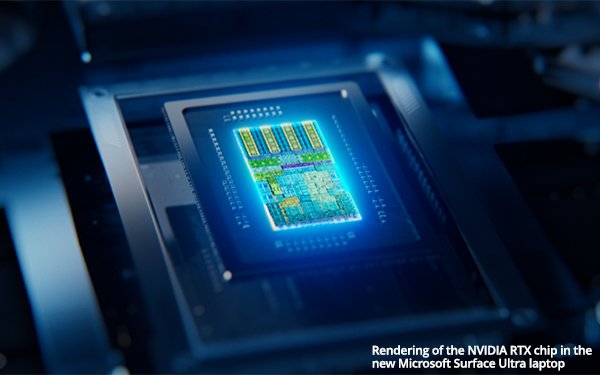
Microsoft launched its "Surface Ultra" laptop Wednesday, which runs
on Nvidia artificial intelligence (AI) chips, around a vision of a "hybrid intelligence" future.
The company has positioned its new laptop to support creative work, image and video
generation and local inference -- with the compute power to smoothly run AI agents that analyze, plan and optimize media buying through ad-platform APIs.
The Surface Laptop undercuts the price
of rival Apple's laptop by a few hundred dollars, and targets the same creator and developer market.
The Microsoft group started with a clear ambition to better serve the needs of creators,
developers and AI builders, Brett Ostrum, corporate vice president of Surface, wrote in a blog post published today.
"The answer wasn’t simply a faster laptop," he wrote. "It meant
fundamentally rethinking what a high-performance Windows PC could be."
advertisement
advertisement
The laptop, which launches Oct. 16, has much more significance for advertising than the company has acknowledged.
Media buyers could run much more AI locally on the machine rather than requiring the signal to go to the cloud and back.
The AI can identify wasted spend, find audience overlap and
recommend the reallocation of budgets much more rapidly
Massive amounts of sensitive data remain on the machine rather than transferring it into the cloud -- including customer lists,
conversion data, CRM data, campaign performance, media plans, audience segments, and more.
Local processing on the machine potentially means that less data will leave the advertiser’s
machine.
Microsoft said the laptop can run models larger than 120 billion parameters locally, with up to 1 petaflop of AI performance.
This could make AI agents much more practical
within agencies, and could have major, long-term advertising implications for the analysis of performance, comparison of historical benchmarks, and generating new creative.
Processing on
laptops takes on greater significance in terms of what it means for platforms like Apple, Google and Meta.
The shift toward AI-driven
interfaces directly threatens the core business models of Google, Meta, and Amazon by altering the ways consumers discover information, products, and services.
When an AI agent acts as the
intermediary, it compresses the traditional multistep discovery process into one direct answer.
Microsoft does not mention this in the announcement, but the shift moves toward putting more
power on the computer and away from platforms and toward advertisers and their agents.