It has been more than three years since
the media planning and buying industry began adopting generative AI tools into their workflow and well over a year since they began testing agentic platforms, and AI has already become baked in with
agents now seen as supplemental members of the team, albeit still more like juniors than mid- to senior talent.
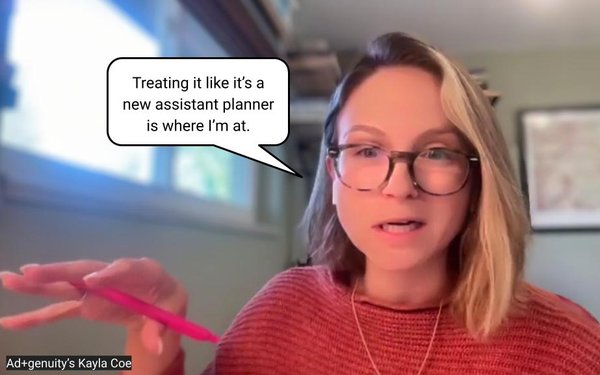
It's almost like having an assistant planner," is how Ad+genuity Director of
Digital Media & Strategy Kayla Coe characterized the current status on her team when I interviewed her late last week ahead of the release of an annual study on the adoption of AI by digital media
planning and buying platform Basis Technologies.
The study's top line: nearly two-thirds (61.4%) of
industry pros it surveyed last summer say they now utilize AI technology every day, which is nearly double the 33.6% from the same survey conducted a year ago.
advertisement
advertisement
While that may or may not seem
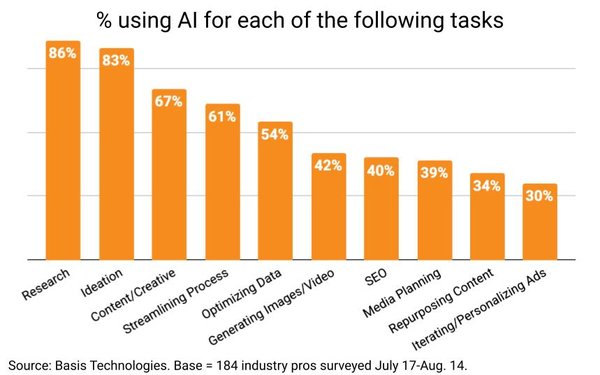
surprising, what I found most interesting was Basis' findings about what tasks AI is being used for, including straight-up media planning.
Two in five respondents said they are using AI as
part of their media-planning process (see above). There was no baseline for the AI task responses from previous Basis studies, but Ad+genuity's Coe says the rapid adoption makes sense, because the
platforms agencies -- especially independents like her's -- use from publishers, DSPs and planning and buying processors have all fully integrated AI chatbots in a way that makes them almost
autonomous.
It has been nearly eight months since her team began beta testing Basis' Compass agent, which was released to the general marketplace in April, and she says usage among her staff
went from trial and tire-kicking to at least "weekly, if not daily."
She says most of the adoption has been on the front end -- automating time-sucking manual steps that human planners would
have had to input -- which is why she characterizes the current state of media-planning agencies as "assistant planners" that have historically done much of the grunt work before senior staff get in
the loop.
In terms of actual strategy, she says the agents are also beginning to influence how the most senior members of the team think -- and what choices they make.
"Sometimes it
will spit out a recommendation that makes me reconsider our first principles like ‘Should I be recommending that? I wouldn’t have thought about that myself,’ but nothing is going to
a client that isn’t from our own human recommendation. Treating it like it’s a new assistant planner is where I’m at."
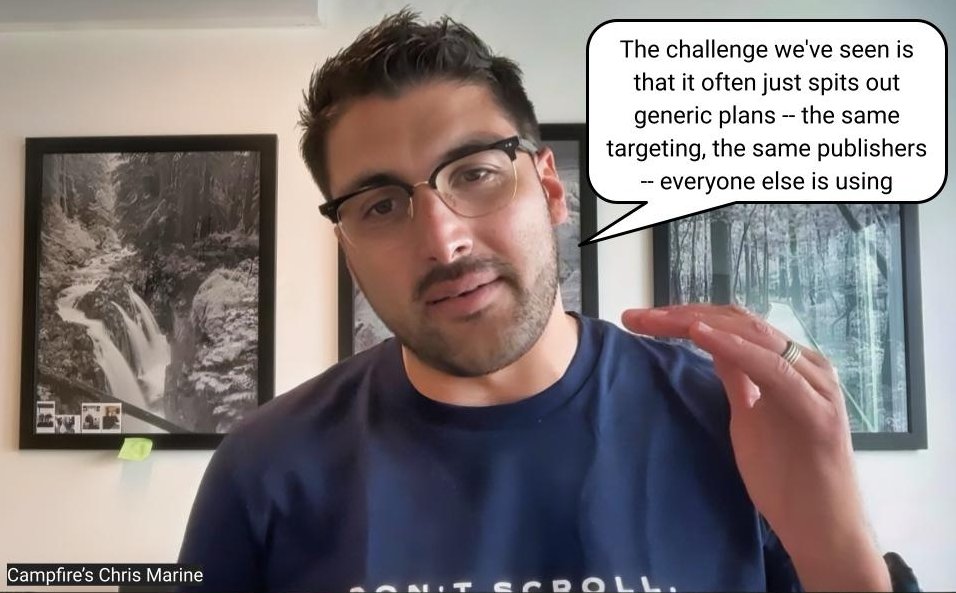
"The challenge we've seen is that it often just spits out generic plans -- the same
targeting, the same publishers -- everyone else is using." That is how Portland, OR-based Campfire Consulting CEO Chris Marine characterizes the current state of agent-based planning.
Campfire
-- which also works with Basis, Viant and other platforms and recently completed a 15-month RFI on the adoption and integration of AI tools across the major DSPs -- concluded that context and nuance
still matters, especially for brands that want to reinforce their differentiation from competitors in their category.
Late last year, it conducted a test of an agentic media system developed
by Scope3 for its client Allagash Brewing, which did yield better results, but only after the agent was trained on Allagash's specific brand standards for actual media environments.
Specifically, Campfire trained the agent to recommend buys for sports-related publishers, but to exclude potentially dangerous sports vs. "brand suitable" sports aligned with Allagash's positioning
around "having fun safely."
"In the process, 83% of generic content was blocked, investment into brand-suitable placements increased 5x, exposure time improved 22%, viewability increased 13%,
and shorter creative reduced per-impression emissions by 22%," Campfire's Marine recalls, adding: "The machine did more work. The human judgment became more important."
Given how rapidly media
planning and buying has already adopted -- and adapted to -- an agentic world, it's hard to imagine what Basis will find if and when it conducts and releases another annual study next year, but in
closing, I asked Ad+genuity's Coe to tell us what she thinks will happen next.
"The vision I have is that there’s going to be one agentic interface that we go to that does all
the things," she said, explaining: "Right now, every vendor and publisher we work with has their own solution that lives in a box. The dream is that they all get integrated into one."