Oxford Road, a Los
Angeles-based advertising agency specializing in audio, released a study this week suggesting YouTube’s podcasting dominance might come with a heavy cost for brand advertisers.
The
Los Angeles-based agency worked with Podscribe, an independent platform for podcast and audio advertising measurement, attribution, and verification, to find the gaps in YouTube's podcasting
ads.
The study, Re-Thinking YouTube: Why Your Video Podcast Ads Are Converting 25% Worse Than Audio, shows that YouTube views are between 18% and 25% less effective than audio
downloads at driving purchases. For every $1 million spent on YouTube podcast impressions, it’s estimated that brand advertisers may lose up to $250,000 in conversion value, according to
the report.
advertisement
advertisement
The shift toward podcast videos has unlocked new audiences for creators and an opportunity for marketers that looks to be productive, notes Dan Granger, CEO of Oxford
Road. YouTube's lack of transparency on performance data is holding back $1 billion in additional spend, Granger wrote.
The data was sourced from more than one thousand campaigns
supported by Oxford Road and Podscribe in which advertising performance had been tracked by promo code redemption, and a survey asking participants “how did you hear about us?” at the
checkout.
The response data was analyzed alongside the delivery of ad impressions across audio and YouTube, which varied extensively across the campaigns, to create an apples-to-apples
estimate of the effectiveness of ads that appeared in both the audio and YouTube versions of a podcast.
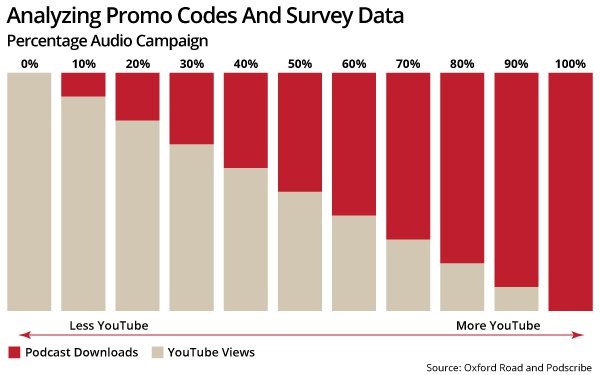
For each individual advertiser, Oxford Road split the campaign into deciles to easily
identify trends and compare those trends consistently across multiple clients. The illustrative column chart shows the percentage of YouTube impressions decreasing from right to left in increments of
10%.
The study suggests that a YouTube exposure does not work as hard per impression as the exposure to an audio-only podcast when it comes to driving the best outcome for advertisers.
A Really Simple Syndication (RSS) feed impression may not be interchangeable with a YouTube view, contrary to what has become a fairly standard practice in the market, according to the report.
Based on internal discussion and anecdotal feedback from the market, the study suggests the following factors for several reasons.
Podcast listening is an intentional lean-in activity,
unlike YouTube viewing, which is often driven by its discovery algorithm -- suggesting more rapid viewer loss on YouTube.
Podcast listeners are typically repeat, loyal listeners who have
established trust in the host, in contrast with spontaneous or first-time YouTube viewers.
Long-term podcast listeners have been conditioned to respond using promo codes over many years. This
has been a way for them to support their favorite shows. This expectation does not exist in the same way in the YouTube environment.
YouTube audiences are often more international, resulting
in ads that may be less relevant to the viewers and therefore may diminish the response.
Views are counted differently than downloads. A podcast download can only be counted once per 24 hours
per piece of content, whereas a YouTube view can be counted multiple times in one day, so it is conceivable that view counts may exceed downloads for the same amount of consumption.