To some, WPP Media might seem like a
questionable pick for MediaPost’s holding company of the year. The year began when recently returned prodigal son Brian Lesser architected the ethically questionable acquisition of InfoSum, a
company he previously ran and still owned equity in, and then immediately scuttling the media-services organization's nearly quarter-century-old GroupM brand as part of a series of reinvention pitches
that were heavy on sizzle reel presentations, but light on under-the-hood substance.
Under the new Lesser vision, the present and future of media-services giants was not in their
ability to amass media marketplace intel and negotiating power -- but in ingesting, aggregating and owning the cleanroom that determined media-marketplace effectiveness.
Rhetoric
aside, Lesser was on to something. And it wasn’t just about controlling the flow of consumer and media market data, but in leveraging automation and rapidly advancing AI technologies to do it
better, faster and -- bonus points -- with far less overhead than conventional data analytics organizations ever could do.
advertisement
advertisement
Still, sizzle aside, much of the reengineering of WPP Media
was kept under the hood, even if parent WPP touted “open”-ness as its mantra. So it wasn’t entirely clear what the end-game was except to move fast, and break old media-services
models.
That was until mid-year, when WPP Media’s Business Intelligence team began rolling out some incredibly forward-thinking industry research that at first seemed kind of
gee whiz, but which by year-end looked more like a blueprint for the future of a data-infused, agentic media-services world.
The first glint of this strategic plan was articulated by
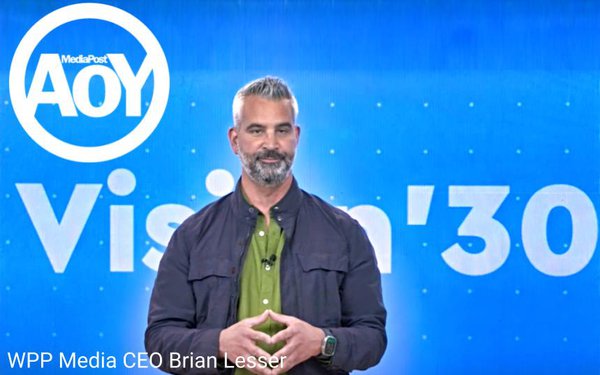
Lesser and his most senior managers during a May 2025 “open house” presented to WPP Media’s worldwide organization explaining the rebranding from GroupM and why it was important to
be fully integrated with parent WPP and its client portfolio, and not just in name only.
Not surprisingly, it focused heavily on the rapid integration of AI and teased the notion of
a "Vision ‘30" game plan.
“It’s a five-year roadmap to create a company that is inherently collaborative, connected and enabled by AI and designed to manage
business outcomes, not just campaigns,” Lesser told the organization, laying out more vision than substance, but setting the stage for specific steps that were even then being put in place.
Specifically, Lesser had asked his Business Intelligence team to conduct some new, primary research among a cross-section of forward-thinking industry thought leaders to begin building an
explicit blueprint.
The first cut of that research was unveiled when the unit’s global President, Kate Scott-Dawkins, briefed journalists and analysts on its mid-year ad
forecast update in June, featuring a sidebar on what would prove to be a blueprint for getting to 2030.
The findings struck on nearly two dozen game-changing 2030 possibilities. But
at the time, I focused my reporting on just one: how likely the 60 experts believed most consumer interactions with
brands would be agent-to-agent by 2030. Remarkably, two-thirds thought so.
I thought that was the end of that story, but was surprised when Scott-Dawkins released a second installment of the “Advertising 2030” findings drilling
down into more of the disruption the industry experts thought was likely.
I thought it was a little odd at the time that WPP Media was doubling down on its seminal findings. But I didn’t
realize how integral it was to the longer-term WPP Media “Vision ‘30” strategic plan until Scott-Dawkins presented her year-end advertising forecast outlook, and included yet another
installment of the research findings in a way that was more of an actionable blueprint.
Actually, she labeled it a “framework,” and it had evolved from some simple futuristic
intel into an explicit model for evaluating the AI-readiness of the ad industry’s major digital media suppliers.
The framework is drawn from the original primary research
that Scott-Dawkins conducted, but was adapted into an explicit points-based system used to grade the ability for each platform to do the kind of business WPP Media envisions on its path to 2030.
As far as I can tell, it is the first structured methodology for rating the AI capabilities of the media supply chain that has been released publicly by any agency, holding company or
other third party to date.
When I asked WPP Media whether it had any plans to advance the methodology as some kind of industry standard -- the way GroupM’s venerable research
team did historically in the past with syndicated media audience ratings, or technical specs for connected TV (CTV) advertising, etc. -- the team demurred. But you know nature abhors a vacuum -- even
if it’s a highly synthetic one.
At year-end, WPP Media announced it would release a more substantive outline of the methodology and application of its new framework at this
year’s CES conference, but at presstime it decided to wait to socialize it with clients and the rest of its organization first. So stay tuned for that. But you can view the last publicly released installment of its progress here.
And while it still is a work
in progress, and WPP Media like much of the rest of its peers, still is in the flux of transformation, the foresight and follow up of at least trying to put a new framework in place, demonstrates
exactly what MediaPost’s agency of the year awards strive to recognize: vision, innovation and industry leadership helping brands connect with consumers via media.
But CEO
Lesser may have described that best when he spoke at the Association of National Advertisers’ annual conference in October 2025, noting: “Despite the challenges of reaching today’s
consumers, there is no better time to be in the marketing business,” adding: “Our role is shifting to that of architects and world-builders,” adding, “I feel today the way I
felt at the dawn of programmatic, like we are leading a period of reinvention. But I know the embrace of AI will be orders of magnitude more significant than any shift our business has ever
experienced.”