Although YouTube continues to
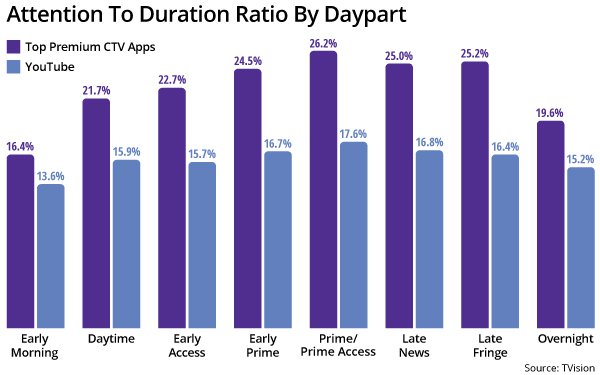
dominate overall streaming viewing share, premium streaming platforms command much more "attention" versus YouTube.
In prime time, for example, premium streaming apps (such as Netflix,
Disney+, HBO Max, etc) pulled in a 26.2% “attention” score versus a 17.6% for YouTube, according to TVision.
TVision defines "attention" as the proportion of viewing ad impressions
where a person had their eyes on the screen for two or more seconds of creative content.
In order to account for a wide range of content duration, TVision metrics are weighted based on
duration of a viewing session.
Other dayparts surveyed also show higher attention scores for premium streamers versus YouTube.
For example, early fringe is at 24.5% for premium, 15.7%
for YouTube, while for the daytime time period, premium comes in at 21.7%, and YouTube at 15.9%.
advertisement
advertisement
Early morning gives premium streamers the narrowest of margins over YouTube -- at 16.4% versus
13.6%.
Looking at overall scores for streaming content -- that factors in “attention” and app reach -- TVision Power Score showed Netflix's program content dominated for the
July-December 2025 period with 11 shows making the top 20, and seven of the top ten.
The top three shows overall were Netflix’s “Wednesday,” “Stranger Things” and
“The Beast In Me.”
Two Paramount+ shows made this list: “Landman” (in fourth place) and “Tulsa King”(tenth place). Peacock had “All Her Fault”
in ninth place.
TVision estimates only three streamers -- YouTube, Netflix, and Amazon Prime Video -- reach the majority of streaming-enabled homes in 2025 -- at 69.4%, 68.6% and 59.2% reach
respectively.
In terms of viewing time, five streamers collectively captured more than half the streaming viewing time in the second half of the year, with YouTube at 21%, Netflix at 14%, Hulu
with 9%, Prime Video at 9% and Peacock at 5%.
TVision uses "eyes on the screen" computer vision technology, measuring person-level, second-by-second engagement for its attention and
viewing data.
Data is collected from an opt-in panel of 5,000 U.S. homes.