The marketing budget as a percent of total revenue
really have not changed much in the past few years, but this year CMOs are giving credit to artificial intelligence (AI) for the ability to do more with less.
CMOs consistently identify AI as
a significant driver of efficiency within their organizations. When asked about the most transformative changes delivering cost efficiencies in 2026, Ewan McIntyre, vice president and analyst and
chief of research at Gartner, told MediaPost that AI-driven capabilities were ranked among the top three responses in Gartner's CMO Spend Survey, released today.
The Gartner CMO Spend Survey
was conducted from January through March 2026 among 401 CMOs and other marketing leaders in North America, United Kingdom and Europe across different industries, company sizes and revenue. The vast
majority of respondents report annual revenue of more than $1 billion.
advertisement
advertisement
The findings also detail how CMOs fund AI initiatives amid continued budget pressures, and how CMOs have expanded the use
of the technology to support all types of strategies.
While CMOs are making significant investments in AI, many marketing organizations lack the maturity needed to scale those investments. The
survey found that CMOs allocate an average of 15.3% of marketing budgets to AI initiatives, while only 30% report mature or fully developed AI readiness capabilities. And with this help, many are
exceeding performance marketing goals.
"AI Strategists," the approximate 30% who "have what it takes to scale AI and deliver real efficiency and growth" put more of the company's marketing
budget into AI and transformations, and now these CMOs hit more goals, McIntyre said.
"The challenge is that most CMOs aren’t there yet," McIntyre said, but it appears CMOs are adapting
to lower average budget levels that have persisted during the past three years.
Strong evidence suggests AI helps CMOs address budget and resource challenges. While most CMOs report
insufficient budget to fully execute their strategies in 2025, fewer are citing this issue in 2026 compared with previous years.
One of the more interesting findings in the
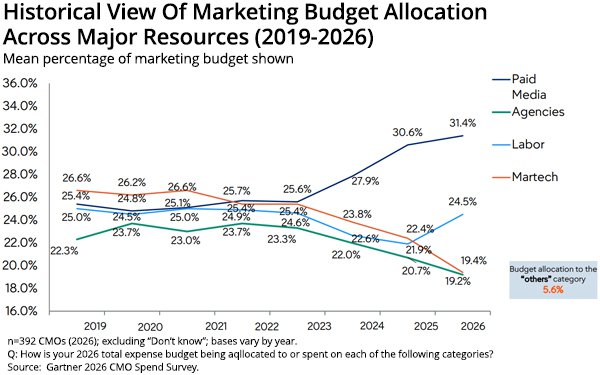
report, CMOs continue to shift budget toward paid media and away from agencies and technology. This year, CMOs said 31.4% will go toward paid media, 24.5% toward labor, 19.4% toward marketing
technology, and 19.2% toward agencies.
The findings also explore how flat marketing budgets are forcing CMOs to make sharper trade-offs around AI, resources and growth priorities,
and why AI-ready marketing organizations may start to take separate actions.
AI-enabled personalization and data quality have emerged as marketings top capability to close all types
of gaps for achieving goals this yearm despite the lack of internal AI talent and data quality experts to drive AI marketing efficiencies.
McIntyre also pointed to Gartner’s CEO and
Senior Business Executive survey that shows enterprise leaders are growing impatient for AI-driven growth and transformation. This survey found 56% of CMOs say their marketing organization
lacks the budget required to deliver their 2026 strategy, while 54% report insufficient resources.
CMOs have a longstanding track record of investing in technology, McIntyre said. In 2026,
19.4% of the marketing budget is allocated to technology, with a substantial portion now directed toward AI solutions. There's a clear shift toward consumption-based pricing, which is
closely associated with AI-powered technology, McIntyre said.
Gartner research also shows the rise of AI as a major factor influencing CMOs' decision to centralize
their marketing functions.
According to the 2025 Gartner Marketing Transformation Survey, 73% of CMOs report their marketing function is now fully or mostly
centralized. The rapid rise of AI is transforming marketing workflows, data management, and content creation. These technologies amplify the benefits of centralization — enabling
greater speed, insight, and cost-effectiveness — while also raising the stakes for operational excellence.