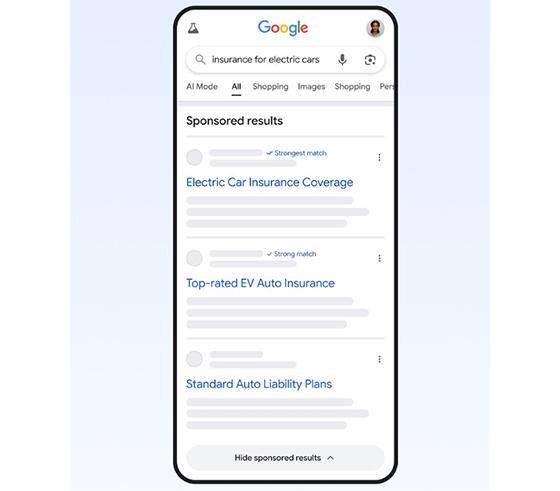
Google continually tests new ways to improve the Search Ads
experience. This week it began running a small experiment by adding what it calls a label for "Strongest match" or "Strong match" to certain Search ads.
Ginny Marvin, Google Ads product
liaison, explained in a post on LinkedIn, that the goal is to "help people instantly identify the most relevant information for their query, and help advertisers connect more effectively with
high-intent audiences."
"We’re always tweaking and testing things, so while I can't promise a preview for every new UI experiment, I thought it’d be fun to share the thinking
behind this one before you start seeing it," Marvin wrote.
The goal is to help people identify the most relevant information for their query, and to help advertisers connect more
effectively with high-intent audiences. The labels are not new inventory categories, but rather a way to identify certain ads that meet a criteria.
advertisement
advertisement
Google calls them "badges," and they are
applied to existing Search ads that are already in use. This really just describes the mechanics, naming, and fundamental purpose of Google’s ad-labeling features.
This is just an
initial experiment for a small percentage of users in the U.S. to help Google assess the value of the change. it's a small experiment that uses existing ad quality and relevance signals to
identify highly relevant Search ads.
Ad quality is an estimate of the experience users have when they see a brand's search ad, as well as the quality of their experience once they reach the
landing page, according to Google documents. The ad-quality assessment is summarized in the advertiser's Quality Score available in their Google Ads account.
Google notes what ad-quality
scores do not impact or influence, such as the amount that marketers bid.
The bid may affect Ad Rank, but it does not impact the assessment of ad quality.
For example, if a car engine
has high efficiency, the driver needs only a small amount of fuel to travel far. This is the same as Ad Rank, where good ad quality will increase the likelihood of a higher ad rank.
Ad Rank is
calculated each time an ad becomes eligible to appear, and then again when it competes in an auction.
Quality also is not affected when an ad group has the same ads and keywords as
another campaign or account.
But when an advertiser moves a keyword to a new ad group that has new ad text, it can change the ad quality because that can affect user experience, Google
explains.
The frequency of ads -- such as how often ads serve up -- is determined by bids, budget, and keyword competition, but it does not affect ad quality.
Reported conversions also
do not impact ad-quality scores.
The announcement of labels for "Strongest match" or "Strong match" in certain Search ads received a mixed reaction on LinkedIn, although mostly positive.
Kristen Kelleher, head of paid search at Neighbor, asked Marvin to explain the components that make up "the scoring underneath the match label?" and added: "Is this based on the keyword based
quality score, ad relevance, landing page exp or is it only based on the ad itself?"
Marvin led Kelleher to a post where she could find more information on ad quality, but also reiterated a
few points, such as "to be clear, though, the badging in this experiment has no impact on the auction or how ads rank," which seemed to be a question that came up a few times.
Justin Windschitl, digital marketing strategist at paid media agency Variable, pointed out that he had interest in learning more about the criteria for labeling “match types” and asked
whether there could be flaws with the labeling that might hurt businesses.
“On the flip side, if it’s buttoned up, it could be very beneficial for filtering best matches and more
effective ad spend!” he wrote.