Agentic search capabilities and
artificial intelligence (AI) this year will bring parents more ways to discover and purchase back-to-school products, but for retailers and brands tracking return on ad spend or return on investments
may not always add up.
Tinuiti, one of the largest independent agencies, studied how parents and primary caregivers will approach back-to-school online purchases this year.
The agency
surveyed 1,040 U.S. adults with school-age children in June 2026. The results reveal how key channels and platforms are playing into school purchases, and what parents are looking for most in the
products they buy.
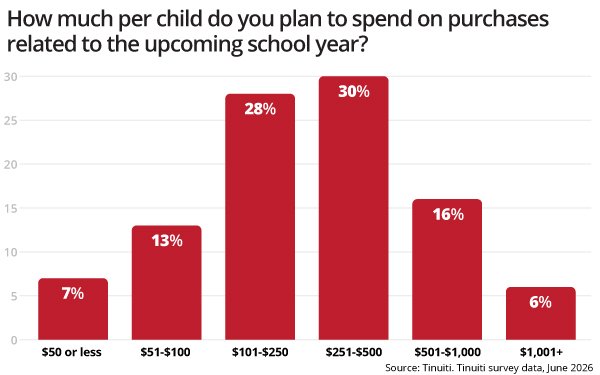
When asked how much they plan to spend per child on purchases related to the 2026-27 school year, 30% of parents said they planned to spend between $251 and $500 -- the most
common answer -- while the second-most common answer, at 28%, was a planned spend of between $101 and $250 per child.
advertisement
advertisement
Fifty-nine percent of respondents say their expenses per child have risen
compared with last year, while just 11% say they are spending less.
Seventy percent of parents supporting college-age students are most likely to spend more per child on school-related
purchases in the coming school year, while 55% of high school parents expect to increase spending lags slightly below average.
While parents of college-age students show more marked
differences in expected purchases, college parents are less likely than parents of younger children to purchase core school supplies and apparel, but much more likely to purchase textbooks, laptops
and furnishings.
Among the respondents who expect to reduce their back-to-school spending, 34% say they plan to cut back most on core school supplies, while 27% plan to spend less on apparel,
and 11% plan to spend less on laptops and other technology products, to round out the top three.
The data shows that 36% of all respondents cited discount stores as the outlets that will get
the majority of their spending. That share rises to 43% for parents who are not confident that they will be able to afford all of the necessary back-to-school supplies for their children this
year.
When asked how much back-to-school shopping they expect to do online, 91% of respondents say they will do at least some online shopping, while 49% will do half or more of their shopping
online. Equal shares of respondents, at 9%, expect to do either all or none of their back-to-school shopping online
There may be one major challenge this year as marketers prepare paid and
organic media for back-to-school sales -- AI citations.
When a company or product appears as a citation in the results of an AI engine, a question remains as to whether the citation
really does send customers to the site cited.
Not all founders of commerce websites can trace specific deals back to AI recommendations, but some can. It’s not clear from the following
research why some can and others cannot.
One thing remains certain -- an attribution gap exists between consumers who see citations, AI-based engines that serve them in query results,
and companies that need them to generate traffic to their sites.
That's according to data published by Tom Pinder, IT specialist and founder of Prapi, a multi-brand PR tool operating
under Startvest, a holding company focused on managing a series of AI-based software-as-a-service products.
Pinder told MediaPost that there is a "method gap, not a tooling gap,"
because "AI referrals are nearly invisible in analytics, they arrive with stripped referrers and no UTM and land in the 'direct' bucket, so conventional tracking shows almost nothing for
anyone."
Those who can trace the citation to ROI do so with what Pinder called a "low-tech thing: they ask. A 'how did you hear about us' field at signup, a post-signup survey, or a
question on the onboarding call, and the buyer volunteers that an AI sent them."
Joe Spisak, founder at Fulfill, traced about $180,000 and 11 customers that way, whereas Narayan Prasath,
founder at Metaflow, went further and segmented raw event data by chatgpt.com and perplexity.ai, Pinder said.
The first report in a series of two suggested
that some website owners could point to specific customers where an AI assistant provided recommendations by name, but did not specifically state why some can and others cannot.
This report
collects firsthand accounts from operators who traced revenue back to citations in ChatGPT, Perplexity, and Gemini, the deals they closed, how fast those buyers converted, and what earned the citation
in the first place.
Jake Wardle, founder of EV Cable Hub, a U.K. retailer of EV charging cables, managed to trace a fleet manager who called in an order for cables and said he had asked
ChatGPT which U.K. shop to trust.
Wardle’s shop name served in the query results, so the customer skipped further searches. The order was worth about 1,400 British pounds. "I would not
have it without the citation,” Pinder wrote in the report, citing Wardle.
In the second report published, Pinder explained a completely different experience. He wrote that “not
every founder watching AI citations has seen a dollar from them,” citing a variety of founders such as Kevin Lourd, founder of Distribute, who monitors inbound traffic for citations from
Perplexity and ChatGPT.
Calling it a “vanity” record, Pinder reported seeing a “complete null result." His brand shows up in AI overviews for queries referencing automated
outbound traffic to his site, but he has not been able to attribute one paying customer directly to an AI recommendation.
Pinder suspects that the traffic comes from AI chats that
generate a much faster signal compared with standard organic search leads.
The "null results," Pinder said, "are mostly 'I can't measure it' -- not 'AI sent no one' to the site."
He
added that this either lands as untracked direct traffic, or the citation is informational -- such as "what is X," rather than an answer that would suggest a commercial use such as what it the "best
X."