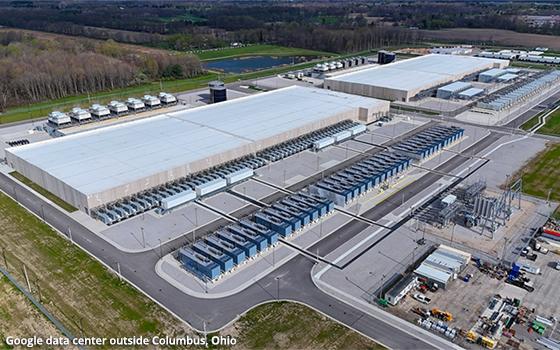
Amazon and Google have pledged to zero out their
respective carbon emissions in the coming years, but their respective sustainability reports for 2025 released this week show that artificial intelligence (AI) has made those goals more difficult to
achieve.
Google's total carbon emissions are up 25% since last year, while Amazon's are up 16%.
Both companies outline in the report that their energy use has increased significantly in
the last year, while their respective use of AI has risen.
The reports outline carbon use, and detail how much pollution their company generates for every dollar of revenue brought in. On the
other hand, several pages discuss the benefits of AI on the environment.
Years of buying renewable power has helped keep costs down, although that may change as the companies invest in other
power sources like natural gas and types of nuclear energy.
advertisement
advertisement
Google’s sustainability
report stated that the company consumed 10.9 billion gallons of water, 34% more than in 2024, used nearly all to cool data centers.
Accelerating progress requires collaboration with
its customers, to help Google customers such as advertising agencies and brands reach their sustainability goals by sharing the tools and resources needed to measure and improve their impact.
Google Cloud offers companies Cloud and AI products and solutions to drive impact for their business and sustainability.
The infrastructure integrates AI-driven intelligence across every
layer of their operations, enabling them to achieve sustainable outcomes. Optimization enables Google's customers to predict climate risks with unprecedented precision.
For example, Google's
partnership with Cronin provides retailers with “plot-level” insights from a dataset that spans one billion acres of farmland. This enables brands to accurately predict harvest windows,
minimize food waste, and proactively mitigate disruptions.
These predictive capabilities also provide the data to validate sustainability claims and ensure regulatory compliance, fostering a
more transparent, future-ready global food system.
Equinix partnered with Google Cloud to build a Sustainability Data Lake on BigQuery to automate data ingestion from over 240 global sites,
transforming a weeks-long manual cleaning process into a source of on-demand, actionable insights. Equinix saw nearly 50% year-over-year growth in customer sustainability requests, making responding
with manual spreadsheets no longer a viable option.
In terms of advertising, Google offers carbon-footprint monitoring for Google Ads to help advertising customers better measure
their emissions from the use of Google advertising products including Display & Video 360, Search Ads 360, Campaign Manager 360, and Google Ads.
This provides carbon emissions
reporting data aligned with the Greenhouse Gas Protocol.
The reports provide detailed breakouts of scope 1, scope 2 -- both for market- and location based-- and scope 3 emissions allocated at
the account level.
Similar to Amazon, Google pays for enough renewable energy to match 100% of what the company uses, giving Google the right to claim it offsets its power use with
low-carbon-emissions sources that use almost no water.
Microsoft recently announced zero-water use data centers, as well as a commitment to what it calls
a “community-first AI infrastructure," which means the company will “replenish more water than we use,” a push to reduce water consumption.
Like Google and Microsoft,
Amazon's aggregate growth in data-center capacity has begun to outpace gains.
Amazon said its data centers use water seven times as efficiently as the industry average, and that the company is 75% of the way to its goal of returning one gallon of water for each one it takes.
Amazon's
greenhouse gas emissions rose more than 16% in 2025, the company stated in the report, fueled largely by a 34% increase in electricity and a 20% increase from manufacturing supply chains.
In a
disclosure published this year, Amazon reported its data centers withdrew 2.48 billion gallons of water.
Some ended up back with the community and not consumed.
The metric used to measure water efficiency at data centers improved 20% since 2024, and more than 50% since 2021.
Preserving
the goal for the future of driving down costs, and conserving water and electricity means finding ways to keep growing economically while protecting our resources. It requires a mix of cleaner energy,
smarter engineering, stricter supply chain rules, and a lot of hard work.
Amazon’s and Google’s dedication mirrors the grit and perseverance of previous generations. Taking on
these challenges is how to honor the legacy of those who built our foundation, this country, so we have it to leave for generations that follow.
It reminds me to thank my grandparents and
parents for the struggles they endured. Those struggles allowed me to become an American girl raised on the promise I could be anything.
When my father wanted me to take a
proficiency test at the University of Irvine to find my strengths, I recognized those strengths on my own and became a writer. Eventually, I landed at MediaPost. It took belief in myself and a lot of
hard work.
Have a safe and happy Independence Day. See you back here on Monday.