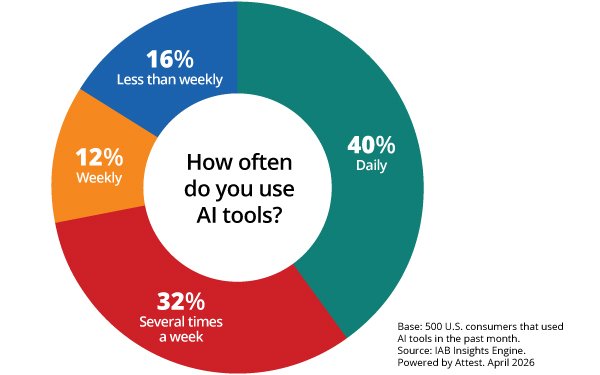
Two complementary studies from the
Interactive Advertising Bureau (IAB) reveal that 40% of consumers use artificial intelligence (AI) daily, and 95% of publishers say large language models (LLMs) have reshaped their business, but
digital advertising still needs stronger trust, infrastructure, attribution standards, and frameworks for long-term growth.
The biggest challenge is that the gap between AI adoption and
industry accountability continues to widen, according to the studies from IAB released last week.
The studies are titled “The AI Adoption Era: From Consumer Usage to Rising
Expectations” and “The AI Discovery Shift: How Publishers Are Navigating LLM-Driven Content Discovery.” The two documents combined pinpoint the gap and what the advertising industry
must do to close it.
advertisement
advertisement
The first study, which surveyed about 500 U.S. consumers using the IAB Insights Engine, suggests that AI delivers mostly positive experiences.
More than 80% of
those participating in the study report they have had favorable experiences, ease of use and the ability to quickly accomplish tasks have helped make AI a valuable tool for those with everyday
needs.
These findings are in stark contrast to many social-media posts across sites such as X, Facebook and Instagram.
Those random users are impressed by what the technology can
achieve, but face moral challenges about the ways the technology is being used.
Accuracy and reliability also remain some of the biggest challenges. While 27% participating in the study said
they do not typically experience frustration, 25% said it takes multiple steps for them to get a “good” answer, while 23% feel they need to double-check or verify the information, 21% said
the AI engine does not understand their request or intent, and 20% said responses are too general or not personalized enough. Some 18% said they receive incorrect or misleading information.
Verification of the results remains a common behavior among AI users.
Some 57% said they always or often verify AI-generated information, while only 2% fully trust responses without
checking.
Some 43% of those who participated in the study have concerns that AI information is inaccurate, while 42% are concerned about keeping the information and data private. There are
also concerns around job displacement and over-reliance, but improving accuracy and protecting user data are critical to sustain adoption.
Trust in AI is growing, but it remains conditional
and is strongly tied to the organizations behind it, with more than 60% of consumers saying a company's reputation impacts how much they trust an AI tool.
As AI becomes more integrated into
daily life, brand credibility is emerging as a powerful differentiator.
The second study focuses on publishers by analyzing how content is measured, monetized, and reviewed.
To better
understand these shifts, the IAB surveyed 110 U.S. publishers. Some 95% reported moderate or significant impact from AI-powered content discovery, despite meaningful changes to traffic and discovery
patterns.
Publishers remain optimistic about AI’s long-term potential, with 80% describing the overall impact as positive, and negative sentiment is relatively limited.
Monetization has moved from experimentation to execution, with more than half saying they have signed AI licensing agreements. Many others have tested new commercial models, partnerships, and
revenue opportunities.
Publishers can see the significant long-term potential in AI, but success will require greater transparency, attribution, measurement, content control, and compensation
models, according to the findings.
The impact of AI-driven discovery for content is being felt mostly by news and financial publishers, with 72% reporting significant effects on their
business.
Some 60% of smaller independent publishers are experiencing outsized disruption, while larger media companies report a more balanced impact, per the IAB, suggesting that scale may
provide greater flexibility as discovery patterns evolve.
AI content discovery is changing the way audiences find and engage with content. Clickthrough rates have dropped to 45%, although the
report did not indicate the severity of the decline in any of this data.
Some 38% said AI or LLMs have affected attribution, and 37% have seen a growing demand for machine-readable
content.
Small and mid-sized digital publishers feel the greatest pressure from declining clickthrough traffic, with 60% reporting reduced referrals from discovery surfaces. Zero clickthrough
rates have become a major challenge.
Half of large media publishers said they are more likely to struggle with attribution, while 56% of news and financial news publishers report changes in
referral traffic patterns.
The effects of AI-driven discovery extend well beyond news content. Some 39% said entertainment and lifestyle content are most affected, followed by 33% who cite
product reviews, video, and B2B/professional content.