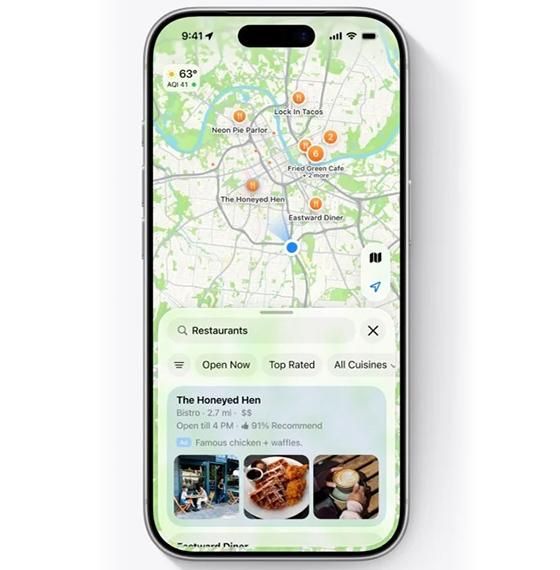
Apple fulfilled a long-awaited promise on Friday to launch
Apple "Ads on Maps," and agencies expect the ad unit will have high-performance metrics for a variety of reasons, but some are disappointed in restrictions the iPhone maker put on the media buys.
The main concern is related to category-specific eligibility, rather than broader hesitation about the value or performance potential of Ads on Maps. The limitations reflect Apple's approach
to complying with applicable regulatory requirements and helping protect consumers in sensitive service categories.
Jon Kagan, director of search and digital media at data-led
performance marketing agency Amsive, uses Apple Apps ads for customer retention, as opposed to prospecting for new clients, for the brands it works with.
He is interested in Ads on Maps
because of the performance aspect, and has met with Apple reps three times to discuss this new format. At the time, they wanted a budget commitment and would not discuss estimates for pricing models
or when it would become available.
advertisement
advertisement
The last conversation Kagan had with an Apple rep was four weeks ago, and perhaps at that time they did not know this information.
On Friday, Apple
Ads on Maps rolled out, allowing businesses in the United States and Canada to purchase media.
Eligible businesses that buy media on Maps via a credit card by October 11, 2026 will receive a
15% monthly credit they can apply to the following month’s spend -- up to $1,000 per month -- for the first year.
In March the company announced it would roll out the platform in summer
2026, and that the ad offering would have the ability to upload photos, add promotional messages and set budgets with no minimum media buy.
Since the privacy approach is for all Apple
Ads, and the company has multiple advertising platforms, Ads on Maps builds on Apple’s privacy approach for advertisers and its platforms.
Kagan said he stopped using ads in Google Maps
“a long time ago” because the format functioned more like a utility app with neutral competition, meaning that all businesses were treated equally based on proximity and utility, rather
than as a tool for building loyalty and brand rewards.
He offered some advice to Apple to explain why he stopped using Google Maps tied to Performance Max campaigns.
"I
can't dictate the allocated spend to maps, and in Demand Gen it is a beta and a little tricky," Kagan said "We use it for brick-and-mortar brands that take walk-in traffic like restaurants. It's about
20% of our search spend."
Agency executives expect the ads to boost performance, and some are also evaluating Apple’s current and possible forthcoming ad units.
Michael
Gullaksen, CEO at performance-based agency NP Digital, told MediaPost that advertising on Apple Maps holds the most interest with brands it works with, especially from financial-services clients.
Executives at NP Digital’s mobile subsidiary Yodel also keep an eye on ad placements in the app store.
“There will definitely be interest in buying ads outside of the
store,” said Mick Rigby, founder of Yodel Mobile. “As one of the key OS operators, Apple Ads currently offers strong results and a lower tracking impact from SKAN, so the potential of this
ad placement's performance is high.”
SKAN, or SKAdNetwork, is Apple’s privacy interface introduced in 2018. It provides advertisers with attribution data for ads running on
iOS to measure and optimize campaigns. It keeps data private by aggregating it without revealing any user-level or device-specific data.
“A change like this could also bring Apple, as a
channel, much closer in capability to Google, which has real strength in terms of being able to find highly relevant users," Rigby said.
PM Digital’s clients are interested in
innovation. The agency already has several brands that use ChatGPT ads.
With Apple Ads, PM Digital typically spends what they can of the client’s budget, but today’s setup of
in-app-store ad placements means there is a limit on the reach. It is typically stifled by the number of searches people make.
Not all in the industry are excited about the exclusion of some
categories.
"Google is quietly squeezing out smaller service businesses, making them buy ads as a substantial part of their advertising offerings and it just makes no sense that Apple
won't let us buy ads on iPhones for some services in their maps as customers geolocate for solutions," Marty Weintraub, founder of Aimclear, told MediaPost, calling it a "deal killer."
Weintraub pointed out how Apple prohibited the broad category of home services businesses, like plumbing, electrical, locksmith, HVAC, pest control, roofing, general contracting services, and
others.
For accepted categories, there are advantages for legitimate advertisers to rise above, with a few caveats. For instance, medical services will require deeper scrutiny, perhaps even a
human editorial review, Weintraub said.
"We like [Ads on Maps] and see it as a potential channel to do the extra work and rise above the din," he said.
Weintraub is in
agreement with some of Apple's philosophy, and protecting brands and consumers is part of it. But the marketing and advertising "universe" tends to pull in brands and require them to pay extra to be
protected.
The positive is that this concept separates Apple and advertisers from hacks and spammers. He said the separation is potentially worth the work and cost, but it could be
damaging to other businesses that "cannot buy their way into the club, even if they are legitimate."