YouTube has changed its measurement structure and
the way views are counted on its platform.
Starting today, views are counted as soon as a video begins to play or someone enters a live broadcast.
An update to calculate YouTube
Partner Program earnings will follow in February 2027, where the long-form video requirement will increase from 4,000 to 8,000 qualified public "watch hours" within the trailing 12 months -- which
could be the reason for this metrics change.
It moves YouTube away from its traditional retention-based view count to an impression-click standard, and will have a significant impact on
public-view metrics for brands and creators.
“Historically, we’ve used multiple view counting systems across different formats,” the company wrote in a post, explaining that it heard how creators want to eliminate this metric because they find it confusing and want to better
understand the true exposure of their content to viewers.
advertisement
advertisement
Beginning Monday, a view will be counted the moment a video begins playing -- from the very first frame.
But this standard,
which begins rolling out globally across all formats today, could present more challenges for marketers.
The platform will count a public or engagement view from the first frame of playback across every format such as long-form video, podcasts and live streams. It brings the rest of YouTube
in line with Shorts, which moved to this type of counting in March
2025.
While YouTube's new counting process will not change the way AI engines cite videos from the platform, the interesting part is how it exposes the difference between human-centric social
metrics and AI-driven data retrieval in citations.
YouTube optimizes its metric to capture and hold human attention spans and instant clicks, while AI engines are moving in the opposite
direction.
This could create challenges for brands and digital creators where a video optimized to YouTube's new "instant-play" view counter could fail in AI-based search, forcing creators to
choose whether they produce content to satisfy the impulsivity of human clicks or to feed AI engines' authoritative knowledge to become a citation in its engine.
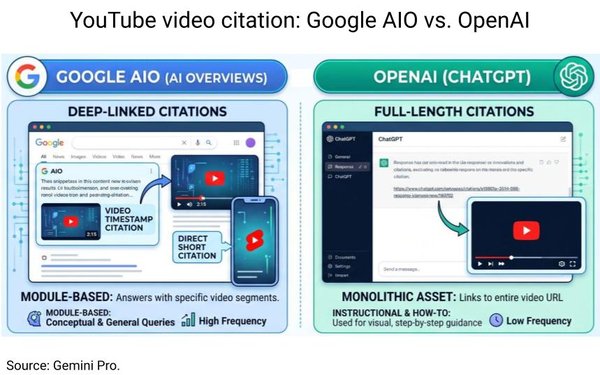
Half of queries citing a
YouTube URL in AIO (AI Overviews) point to a specific timestamp inside the video, rather than citing the entire video, according to BrightEdge data.
The citation only cites 40 seconds of
the video. Short-form videos are cited in AIO 17.5% of the time.
“Google AI Overviews point to the moment inside it answers the question,” said Jim Yu, BrightEdge CEO.
“ChatGPT selects the entire video and serves the citation closer to a decision.”
For each engine, BrightEdge measured Google AIO and OpenAI ChatGPT, the distribution of cited
YouTube URLs by type and the distribution of cited prompts by the stage of purchase intent and question type.
URL types were classified from the URL structure, and intent was classified from
the prompt text.
Findings are reported as proportions within an engine, so that differences between engines remain the unit of analysis rather than differences in the size of either prompt
set.
The data was fielded from May 17, 2026 through August 2, 2026.
In Google AIO, YouTube citations are cited more often.
Rounding out the top five were ecommerce
-- which was cited 32.3% of the time -- followed by finance cited at 27.5% of the time, restaurants cited 25.8% of the time, education cited 24.3% of the time, B2B cited 23.2% of the time and
insurance cited 22.4% of the time.
Lower citation volume does not mean less relevance for the content that serves up in the citation, according to the data.
OpenAI ChatGPT cites
YouTube videos less often and later in the marketing funnel, but Yu suggests marketers should consider citation volume and citation position as two separate strategies.
Although ChatGPT cites
YouTube less often than Google AIO, its citations tend to appear closer to the point when consumers are ready to decide on a purchase.
Since data shows Google AIO and OpenAI ChatGPT analyze a
video to use in two different ways, Yu said these two approaches reward different objectives, which changes the way brands need to treat their YouTube libraries.
He suggests that marketers
treat these processes less like a media channel and more like a database, and structure the data once so it works across all AI engines.
AIOs can cite a long video covering six topics multiple
times because each chapter may answer a different query.
ChatGPT has a difficult time doing the same because the engine considers the entire asset when making the decision to serve up the
citation.
In this instance, the chances of being cited in one engine can improve, while the chances for the other worsen, and it is not a possible tradeoff for brands that are attempting to be
cited in all engines.
Since neither engine can watch the video yet and decide, the chapters and the uploaded transcripts -- not auto-captions -- determine whether the video will receive a
citation. Brands can apply this to libraries they already own.
Yu also mentioned that reporting and measurement structures must change. When a report identifies that a video has been cited, it
does not suggest whether the video or one moment of the video earned the citation.