The recent stabilization in user loyalty toward specific
artificial intelligence (AI) platforms represents a massive shift for the digital advertising ecosystem.
As users move past the novelty of jumping from one bot to the next, many have begun to
settle into routines with preferred chatbots.
advertisement
advertisement
The implications for advertisers are reshaping the traditional marketing funnel.
AI assistants have become a daily
habit for many users who appear to stick with the same ones, and prefer to become more familiar with them rather than hop around.
So what does that mean for advertisers, referral traffic to
websites, and budgets for media buys?
First Page Sage, a U.S.-based agency that supports search engine optimization (SEO) and generative engine optimization
(GEO), compiled data from 16 unique sources to estimate ChatGPT’s use and retention rates as of September 2026.
Since each source of the data had a different
methodology for calculating use, the agency's model used a weighted average of all sources, with the weights based on the source’s longevity, credibility, and reputed accuracy.
Then it
applied its model to the following 12 months to create a snapshot of ChatGPT's use trends.
The data estimates 904 million users when combining OpenAI ChatGPT and Microsoft Copilot -- up
from 805 million in August 2025.
As of August 2026, ChatGPT owns 60.5% AI search market share and 6.4 billion visits.
Top consumer industries where customers are using
ChatGPT to assist with making purchases includes travel and hospitality in which First Page Sage estimates has had an impact of $1.48 trillion within the past year. While at most 47% of the
members of an industry use ChatGPT in their purchasing journey, that number has increased in each of the last 10 months.
The consumer shopping experience could become CHatGPT rather
than the retail website, but in March OpenAI updated its policies to allow merchants to use their own checkout experiences and technology, while continuing to develop deeper native commerce
experiences.
ChatGPT allows the user to set up a stock or tracking alert for specific items.
I set up an alert on a specific dress. It tells me daily if the price has dropped or has
come back in stock in my size. You also can set up an agent to check multiple stores, check prices, and make the purchase on a human's behalf, giving the green light up front under strict rules,
such as under a certain price.
In the case of agentic buying, this means ChatGPT would handle the transaction and the person would never need to go to the merchant's website.
For
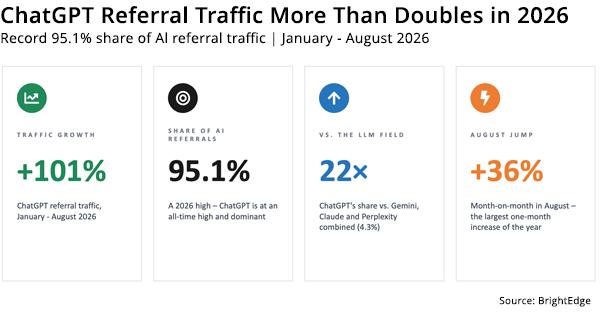
now, new data from the SEO agency BrightEdge released today shows ChatGPT has widened its lead as the dominant source of AI referral traffic to brands.
In fact, referral traffic from ChatGPT
rose 101% from January to August this year, while its share of AI-generated referrals rose to a 2026 high of 95.1%.
OpenAI ChatGPT now accounts for roughly 22 times the combined AI
referral share of Gemini, Claude and Perplexity, according to BrightEdge data released today.
The rebound picked up speed -- especially in August, when ChatGPT referral traffic jumped 36%,
compared with the previous month, its largest one-month increase of the year.
Gemini grew a mere 1%, while Claude declined 15% and Perplexity declined 17%.
Adthena, an AI-driven
search intelligence and competitive analysis agency, shows a sharp increase in advertiser activity in ChatGPT ads.
The company's monthly data pulse tracks AI auctions, paid-search
market-share shifts, and ChatGPT ad activity.
ChatGPT ad presence continues to climb weekly, according to Adthena data, which has
tracked the number of unique advertisers appearing in ChatGPT ads each week from July 9 to August 31.
During that time, weekly advertiser volume grew from 7,306 to 12,075 -- up roughly
65% -- peaking at 13,009 during the week of Aug. 10, 2026.
Google AI Overviews (AIO) ads are becoming shorter. Between one- and two-word queries now command more than half of Google AI
Overviews ads served in every market segment.
In Asia that peaked at 74.4%. Of 288.6 million total AI Overviews ad served in the U.S., 62.9% were between one and two words.