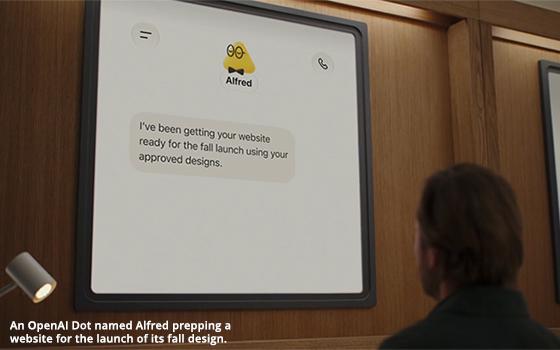
OpenAI kicked off its developers conference this week as the company
announced a slew of new artificial intelligence (AI) products.
While the ChatGPT maker paused development on its GPT-6.1 Astra model due to safety concerns, it has released a competitor to
Meta Platform's Muse and expanded its partnership with Adobe.
"Dots," the company's new, "always on" personal agentic assistant clearly became the focus at the conference.
Powered by the GPT-6 Astra model -- an earlier version of the one OpenAI put on hold -- Dots move beyond the prompt-and-response chatbot format.
The agentic AI tool, which launched in the
U.S. but not in the European Union (EU) or the United Kingdom (U.K.) due to regulatory delays, has its own cloud computer, learns from feedback over time, and is capable of working toward
human-defined goals. Through OpenAI's ecosystem of plugins, it can connect to more than 4,000 apps, giving it other tools to assist wherever needed.
advertisement
advertisement
Agentic agents like OpenAI's Dots and
Meta's Muse will change the way ads are targeted and content is created, as well as privacy preferences and where consumers discover brands.
Instead of consumers searching for products via
traditional engines, these always-on agents can anticipate user needs and create entirely new interactions between consumers and brands.
While traditional ads once relied on keywords or
general browsing history, agents understand a user's intent and preferences, thinking style and long-term goals.
The agents learn from feedback over time. A brand that delivers a successful
product or service to a Dot can secure long-term, automated re-orders without having to keep winning the customer back through expensive continuous ad campaigns.
The user gives Dots access and
approvals through existing ChatGPT app controls. It starts with built-in rules for when to act independently and when to ask for approval. Custom Rules allow the user to perform specific actions,
require approval, or block them with built-in safety requirements.
IDC Global estimates the next year-and-a-half of programmatic advertising will rely on privacy-enhancing technologies, and
that by 2028, 75% of consumer discovery will originate from AI-generated summaries.
OpenAI's marketing pitch highlighted how Dots "can do nearly anything using their own cloud computer, their
own browser, and the apps you’ve connected.”
Dots also connect to other devices in addition to their own, and the user can give their dot permission to connect and use their
laptop.
OpenAI CEO Sam Altman positioned the product during the developers’ conference as a structural shift rather than a feature update.
Altman said Dots are always
within reach, whether through ChatGPT, Slack, or Microsoft Teams.
Users can ask questions, explore ideas, and provide feedback, and can join a voice call when needed. The more a human works
with Dots, the more the technology learns specific preferences and how the user thinks.
Dots lag Meta's Muse in terms of adoption based on the timing of each company's respective release data.
The Muse AI app has 3.4 million downloads, according to Sensor Tower. Within 10 days it held most of Meta's own in-house advertising slots. Muse was introduced September 8.
Early
data from Human Security shows Muse accounts for an average of 72% of daily AI agent requests, and hit 5.6 million requests in less than two days, a volume that took ChatGPT eleven months to reach.
Human began tracking Meta's Muse on Sept. 22.