Fun fact about most-read articles-of-the-year roundups: They don't
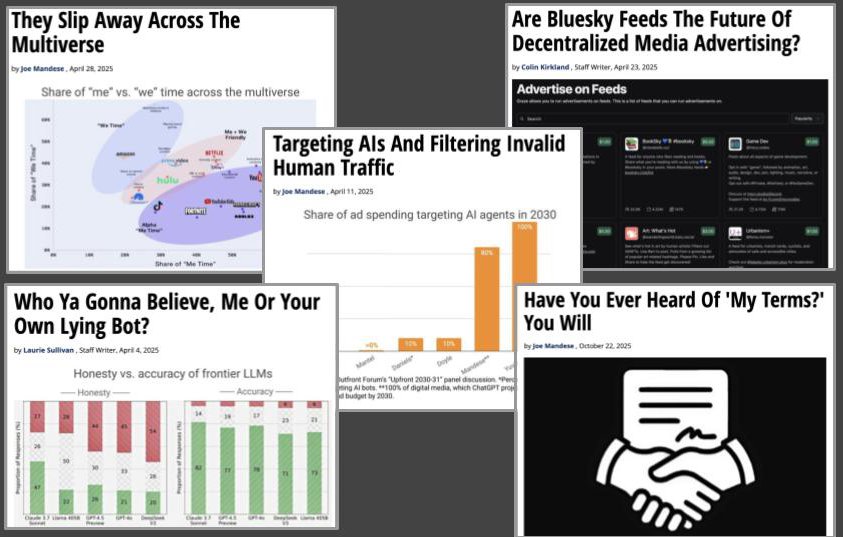
always include one of the editor's favorites. But this year's top "Media 3.0" apparently resonated with readers as much as it did with me: my April 11 post ("Targeting AIs And Filtering Invalid Human Traffic") publishing results of an
impromptu poll I asked my "Upfront 2030-31" panelists at MediaPost's Outfront Forum.
My question: How much of your
2030 advertising budgets will be spent targeting bots, not people? The range of responses was from 0% to 100%, both of which I think are impossible. My own prediction was 80%, because I still don't
now how AI agents can be proxies for consumers being targeted in real life via analogue media, even by 2030. (Analogue media is projected to fall to 20% of all ad-supported media by 2030.)
advertisement
advertisement
In
retrospect, I have to admit the question was a little hot and maybe a little too high-concept for April. But as the year progressed, the high end of the 2030 scenario seems more and more
plausible.
And if I can tout the headline, I was amazed a few months later that it presaged a major ad-verification service -- DoubleVerify -- actually getting into the business of validating non-human
traffic. Things are evolving fast.
The second most-read "3.0" was my April 28 post ("They Slip Away Across The Multiverse") about a Horizon Media study analyzing how the
multiverse is impacting the behavior of Gen Alpha, as well as Millennial families.
"This isn’t just a generational shift," Blue Hour Head of Strategy Matt Higgins asserted, adding:
"It’s a preview of where everything will move. Alpha-Millennial households are living inside a new consumption model and signal what's ahead for all consumers: multi-platform, interest-driven,
and accelerated. Brands that understand and adapt to these new realities now will have a significant competitive advantage in the next decade.”
No. 3 was my colleague Colin Kirkland's
April 23 post ("Are Bluesky Feeds The Future Of Decentralized Media
Advertising?"), a high-level analysis of how the burgeoning social platform is becoming a testbed for decentralized ad-supported media.
"By tapping into custom feeds on Bluesky,
advertisers can target specific audiences through niche topics, or a wider audience on more general/populated feeds," Kirkland opined, adding, "Once approached by an advertiser, a feed operator --
which is effectively an everyday Bluesky user -- has the ability to control which ads run, while also giving the feed's users the choice to opt out of ads by blocking sponsored hashtags."
The
fourth most-read "3.0" was my colleague Laurie Sullivan's April 4 column ("Who Ya
Gonna Believe, My Or Your Own Lying Bot?"), which dove into new research analyzing the underlying honesty and accuracy of the major foundational LLMs. Notably, it did not include xAI's Grok, but
you might be surprised to learn which one is most honest.
No. 5 on this year's most-read list was my Oct. 22 post ("Have You Ever Heard Of My Terms? You Will") about a new, machine-readable technical
standard developed by the IEEE (the same organization that developed universal standards like WiFi, etc.) that will enable consumers to set the terms of their interactions with companies they do
business with -- especially advertisers, data brokers, and others involved in consumer data-privacy compliance. The concept for the standard was conceived by Doc Searls' Project VRM, and branded with
the more human-friendly moniker "MyTerms" (the IEEE's code name is "P7012").
If you ask me, MyTerms, which will roll out in commercial
application tests during 2026, is one of the biggest developments for the ad industry in 2025 and will have implications far into the future as we shift from conventional "CRM," "B2C" and other
acronyms to more of an A2A business model. If you don't already know, that's agent-to-agent.
There were many other important "3.0"s I could cite, including former Interpublic agency MRM (now
Omnicom's) rollout of a ARM (agent relationship management) practice, which was the reason MediaPost selected it as our "Media Agency of the Year" for 2025.
Honestly, most of what we published
this past year was pretty important and often prescient about the future of ad-supported media and media technologies. And I for one can't wait to dig deeper in 2026.
Happy New Year.
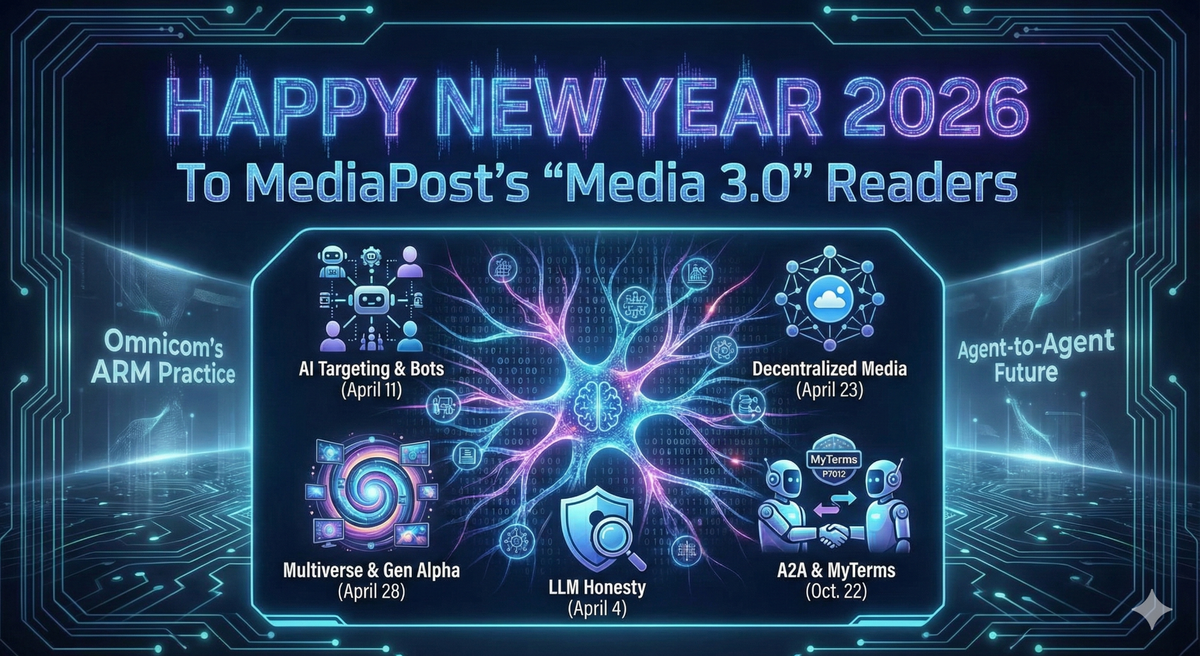
Or as Google's Gemini rendered it after I uploaded this column as a prompt...