The Advertising Research Foundation's Coalition for Innovative Media Measurement (CIMM) this
morning unveiled findings of months-long marketplace assessment for the economic viability of multiple new advertising currencies and determined there's room for just two.
The finding should
not come as much of a surprise, for a couple of reasons.
One, that's what its authors -- audience measurement research veterans Josh Chasin and Manish Bhatia -- predicted when they announced
the initiative at the CIMM East summit in the spring of 2025.
And two, that has been the historic precedent for ad-market currencies in the past.
Remember Arbitron vs. Nielsen in local
broadcast measurement? Or MRI and Simmons in magazine audience measurement?
advertisement
advertisement
Or Nielsen versus any number of fill-in-the-blank players attempting to dethrone it in national TV audience
measurement (see AGB, ScanAmerica, R.D. Percy, SMART TV, for starters)?
I'm not sure what the imperative was to conduct a new, contemporary economic assessment, but it probably has something
to do with the fact that there is an overabundance of alternative currencies vying to dethrone -- or at least compete with -- Nielsen as the dominant ad industry currency.
I mean, there
already are three alternatives to Nielsen -- Comscore, iSpot and VideoAmp --
certified by the so-called JIC organized by OpenAP.
Assuming no one else joins what the new CIMM report oddly calls the "the fiesta," that makes four possible national "cross-platform"
advertising currencies in a market the experts say can only support two, financially.
(I think the study's "fiesta" terminology emanated from a quip at the CIMM East summit and regular
MediaPost op-ed contributor Tony Jarvis' follow up column about it.)
Read the report to understand the economics of a two-ad
currency supply chain, but what I'm most interested in is not what the market will bear for currency providers, but what the presence of two viable currencies have on the supply and demand of the
advertising marketplace.
I was just a cub ad trade reporter when Arbitron's numbers competed with Nielsen's in local media markets, or when publishers and agencies would haggle over the
differing methods of MRI and Simmons, but I seem to recall there was a significant amount of marketplace confusion, or what economists would call "information asymmetry" because of it.
Just
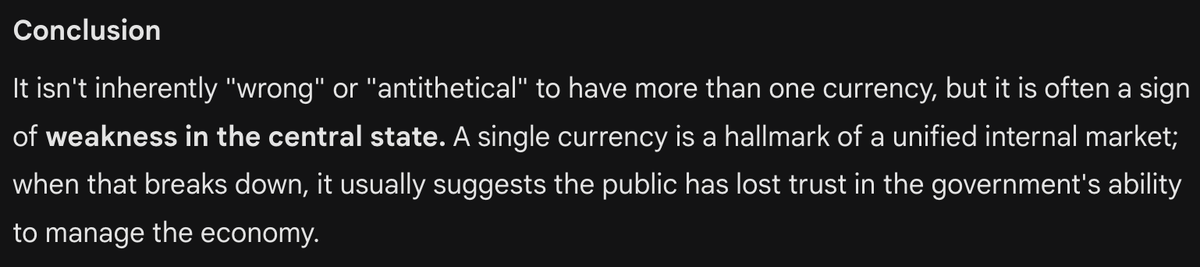
for the heck of it, I asked a couple of LLMs how common it is for the coexistence of economic currencies across the world's nations, and while it isn't that uncommon or "antithetical," the conclusion
is it sends a signal of "weakness in the central state," because the public loses trust in the government's ability to manage its economy.
Not sure how that applies to industries, but if you
ask me, it's the greatest reason why the U.S. ad industry should have a genuine JIC -- joint industry committee representing advertisers, agencies and the media -- setting the standards and sourcing
its currency from the best supplier competing for the right to manage it. You know, how it works in much of the rest of the world's advertising markets.