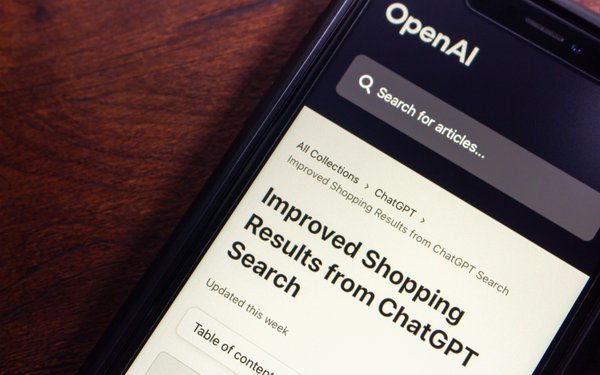
OpenAI CEO Sam Altman has been looking to raise
up to $100 billion in a fundraising round to take the company through an initial public offering by the end of this year.
The company is valued at around $500 billion, MorningStar estimates,
and has accelerated its fundraising, reportedly hoping to reach its goal, while Anthropic, which makes the Claude chatbot, is said to be looking to raise about $20 billion.
This funding
requires a return on investment and, of course, one way to get it means putting ads or sponsored content in chatbot query results. Altman already confirmed OpenAI’s position in advertising,
which requires its algorithms to convince those using the AI engine to return the best recommendations for products and services.
Consumers are more valuable in the long term when they search and discover a brand through an AI engine. Results are more personalized and have been shown to boost the average
order value by guiding shoppers toward higher-value items that better match their requirements.
advertisement
advertisement
Marketers understand AI moved search engine optimization (SEO) to answer engine
optimization (AEO) or whatever they choose. ChatGPT built its own in-house search index as well as uses third-party technologies in Microsoft Bing. It also licensed data providers to provide
higher-quality, up-to-date information.
Changing AI answers is easier for some topics than for others, Nick Koudas, a professor of computer science at the University of Toronto and author of a
recent paper on the subject, told The Wall Street Journal.
Think of AI as a human expert, Koudas told the
WSJ.
Technology executives at companies like Google and Microsoft, even OpenAI like to think of their models as knowledge experts, but answers are only as good as the data
feed into their large language models (LLMs). Those trained to have significant knowledge on a subject makes it more difficult to change its response. People work in the same way, They are more easily
swayed with less knowledge on a topic.
Evan Bailyn, CEO at First Page Sage, which began as an SEO company, and now supports AI optimization. Referral traffic, which sends consumers from
a chatbot to a brand's website or apps, has become the currency for search
A year ago, 90% of that traffic came from Google, Bailyn told the WSJ, but last summer AI chatbot referral traffic
began to rise.; Now, Bailyn says, on average 44% of his clients’ referrals come from AI.
For Bailyn, it’s an opportunity. Many of Bailyn's clients are midmarket
companies that make specialized products, from industrial fittings or hot tubs to compete firms that offer similar products.
One very important point Bailyn made to the WSJ focuses on boosting
placement of these companies’ products in AI results. He called it “brand authority statement,” trust, credibility, and influence a brand holds, which is similar to the tactics
used in SEO.
BrightEdge analyzed patterns for citations and mentions across four major AI platforms to understand percentage changes and shares, correlation between citation frequency and
volatility, domain type volatility patterns, engine-specific stability characteristics, and market share impact on citation consistency.
What researchers found from the
data--while each AI engine shows different baseline volatility--Perplexity at 72.8%, and Google AIO at 41.8%--all engines stabilize around high-authority domains. Domains cited frequently
experience 0.7% weekly volatility, while those cited sporadically swing 50% or more—a 70x difference that holds across every platform, BrightEdge reported.
Ahrefs research published in June 2025 found visitors from AI-powered search platforms convert at rates 23 times higher
than conventional search engine visits, though the results like doesn’t come as a surprise to anyone.
Despite representing just 0.5% of total website visits, AI search visitors generated
12.1% of all signups during the measurement period.
Google Maps SEO is the process of optimizing business listing to appear higher in
Google Maps search results, and it’s just a matter of time before OpenAI tries to do the same. Nearly
90% of consumers use Google Maps, and 46% of all Google searches have local intent, which is why it’s important
for companies to show up in these results.
Ranking high in traditional SEO through Google results can help a company’s position in AI’s results, but bots also look for those
superlatives, notes the report, like “top performer” and “most cited,” because they are not just surfacing results, they’re trying to string together a narrative, Bailyn
said.
Bots also look for praise, which human recommendations help with. I have seen that myself. Bots are programmed to value sources, some more than others, so a review carries a lot of
weight in its determination on what to serve up.
This also is where ads will come in. How many ads for a specific company are served up in results and how many times was that ad clicked on.
The variety of signals chatbots rely on today and in the future will become positive for brands, whether or not they learn how to manipulate the outcome.