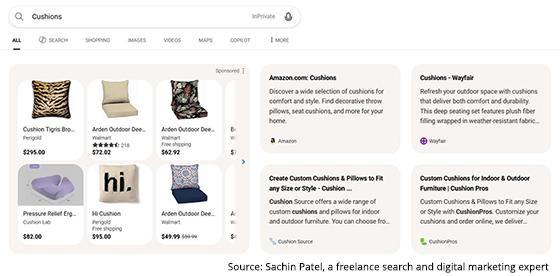
A Microsoft Advertising two-tier sponsored product carousel on Bing would expand the company's ecommerce footprint to compete better with
Google. It appears the company is testing the design for this carousel.
Sachin Patel, a freelance search and digital marketing expert, spotted the limited test this week.
The
test -- a format that pairs a large, double-row sponsored carousel with organic cards from individual websites listed beneath it -- could increase the number of products added to the shopping
cart.
Bing, an AI-powered search and answer engine, offers features such as Copilot, Visual Search and Image/Video Creator. As of February 2026, it holds a 5.11% share of the worldwide
search engine market.
advertisement
advertisement
A YouTube video published in January 2026 explains that Bing frequently offers lower cost-per-click
(CPC) and higher conversion rates for ecommerce. Theoretically, it makes "Add to Cart" (ATC) events more valuable.
Patel often spots tests run by Google and Bing. Another recent
citing revealed Bing lite sponsored tags, which use transparent, low contrast "Sponsored" labels on search advertisements.
These may intentionally be difficult to see, often appearing in
a very light gray font that blends into the white background. Bing also seems to have tested these sponsored tags in 2024.
The double-row format in Bing should produce better performance
for specific SKUs that might have previously been buried in a single-row format. It also could capitalize on Bing’s AI capabilities like Copilot. The carousels can more accurately map a broader
range of products to complex user queries, as consumers add words and descriptions to searches.
Brands that advertise will also have the ability to include LinkedIn professional
data in search and shopping campaigns, expanding on visibility.
It appears that Microsoft has been pushing to make changes across search related to ecommerce. Navah Hopkins, Microsoft
Advertising liaison, recently announced an ecommerce update on LinkedIn.
“You can now update your Merchant
Center store name and/or domain right from Merchant Center!" Hopkins wrote.
This means brands can now make store name changes, but this requires editorial review before it goes live, and ads
will continue running with the current approved name while under review.
Store domain with URL changes require domain ownership verification before going live, and ads will continue to
serve on the old domain until the new one is verified. Product URLs must match the new domain after approval.
Hopkins also noted that store names or domains can be reused if the store
name passes editorial checks and the domain is verified and owned by the merchant.