YouTube
rolled out interactive and immersive features including conversational AI search, gaming title cards, family groups, and chapter navigation to smart TVs and gaming consoles in its Q1 2026 update, but
the company has its eyes firmly on artificial intelligence (AI).
Improvements to the YouTube viewing experience on smart TVs and gaming consoles were developed to provide a more
intelligent and seamlessly interactive experience.
The AI tools on TV support the logic of reducing the number of actions a user may take to get all the information they need without clicking
through to another page, according to an announcement made by Dave of TeamYouTube on the company's official community blog on Thursday.
If this sounds familiar, Google did the same with
search.
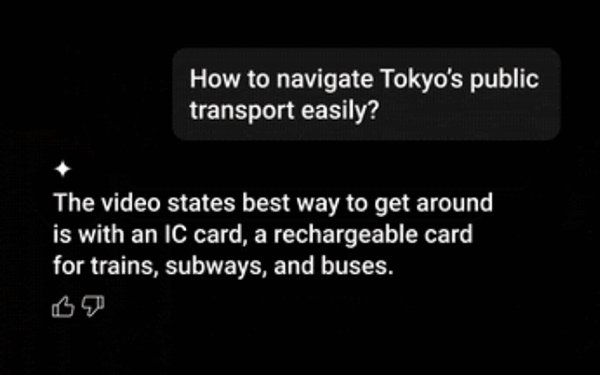
The conversational AI tool for television devices, previously accessible to users on other platforms, is now available via remote control where viewers can activate the feature
either by using the remote's built-in microphone or by selecting the "sparkle" icon on the screen.
advertisement
advertisement
The tool allows viewers to ask questions about the video playing at the time without stopping
playback, and can operate with the video stream rather than replace it. It's kind of neat, because someone could watch a travel video about Yellowstone in Wyoming, for example, and ask follow-up
questions about specific places to stay as the video runs on screen.
Dave's post really resonated with me when I read in an email last week that "YouTube is out" and an AI start-up is
"in" at VidCon's annual creator conference in Anaheim, California.
The annual event, which sits at the intersection of what has been called the "creator economy" -- announced
that POP.STORE, the creator monetization platform for creators, took the official title sponsorship for the 15th annual VidCom show.
As the official title sponsor, POP.STORE will
unveil ECHO-ME, the first agentic AI commerce platform built for creators. This could say a lot about where the creator economy has come from and where it's going.
I attended the
first VidCon in Anaheim where Shishir Mehrotra, vice president of product management of Google/YouTube, gave the keynote.
The primary keynote speaker from Google/YouTube at VidCon
2010 was Shishir Mehrotra, who was serving as YouTube's vice president of product management at the time. After handing the title sponsorship to TikTok to highlight short-form videos, the title
sponsorship now goes this year to POP.STORE.
Its CEO Gautam Goswami will open VidCon Anaheim 2026 with content creator and journalist Jon Youshaei, including a live demo of how
creators are starting to use AI agents to manage storefronts, audiences, and conversion in real time.
The creator thread as a performance strategy leads to Microsoft's LinkedIn, where in
a headline on Business Insider it describes how the B2B social network wants to "host thousands of events a year as part of its bet on creators."
LinkedIn, in fact, has plans to
launch events featuring creators in the second half of this year, Business Insider reported, citing company documents. In fact, it wants to host as many as 4,000 events annually featuring
creators.
"We're seeing strong demand for tools that help creators build sustainable businesses and for members to have direct access to trusted experts," the spokesperson wrote in an email to
Business Insider. "And early pilot sessions this week with leaders like Cassie Kozyrkov, Codie Sanchez, Chris Do, and Lorraine Lee show strong appetite for this type of learning."
LinkedIn had
dabbled in video for about 10 years when features rolled out with a limited group of "Influencers." The platform officially launched video capabilities for all users in August 2017, allowing
uploads via its mobile apps after testing began in July 2017.
Now, it appears, the company is getting serious and has begun pushing videos and producing original shows featuring creators such
as "Diary of a CEO" podcast host Steven Bartlett. It may have a lot of catching up to YouTube, but its strategy is well on its way.
Interesting data also emerged. For the first time, LinkedIn
has overtaken YouTube as B2B's primary video channel, according to finding from Wistia's 2026 State of Video Report that draws on 13 million videos analyzed, more than 79 million hours, and a survey of nearly 1,000 marketers.
Some 81% of
teams now name LinkedIn their primary video channel, up 33 points since 2024. It beat YouTube on repurposed clips and paid video ads too. Social engagement is the fastest-rising success metric, the
top KPI for nearly a quarter of marketers, almost double a year ago. Views are losing ground to reactions. Budgets are flat or shrinking for 51% of companies, even as video gets more central. Teams
are doing more with the same.
Discovery now happens in the feed, but revenue still happens on-site, social is top of funnel, not the close.