A recent analysis of
companies that tracks digital media payments and invoices across the ad industry shows more than half made to publishers and platforms are now late - and the problem appears to be getting worse.
The Kaplan Group -- a commercial collection agency -- complied a list, pulling information from companies including Remote, Bonsai and many others to show record-high late-payment rates across much
of media and advertising in 2025.
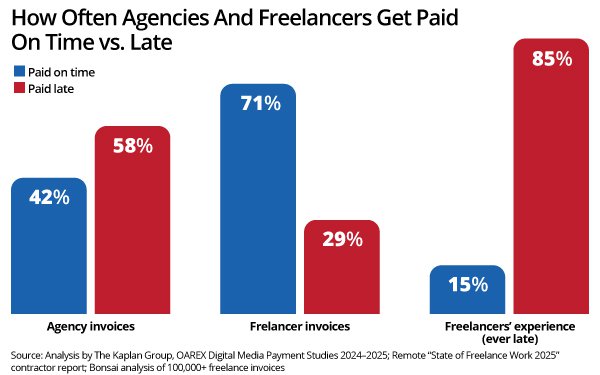
The aggregated data found that the State of Freelance Work 2025 report from Remote reported that 85% of freelancers experience late payments at
least some of the time, and 21% are paid late -- or not paid at all -- more than half the time.
These results, combined with invoice-level analysis by Bonsai that draws on data from more
than 100,000 freelancers over a three-year period, revealed that 29% of all freelance invoices are paid one or more days late. Female freelancers were found to receive late payments
on 31% of invoices, compared with 24% for male freelancers.
advertisement
advertisement
Sector-specific research adds more detail from a study of creative industry freelancers in the U.K., which found
that nearly half of all invoices to creative freelancers are paid late, with the average invoice amounting to a waiting period for payment up to 90 days after services are rendered.
Larger companies are more likely to pay late than smaller businesses, at 51% versus 41%.
The collection agency highlights New York City’s Freelance Isn’t
Free Act, which has been in effect since 2017. It requires that written contracts and payment be made within 30 days for covered freelance work, and allows freelancers to recover double
damages plus attorney’s fees for non-payment and late payment, according to The Kaplan Group.
The city’s Department of Consumer and Worker Protection five-year report shows
there were 2,542 complaints filed between 2019 and 2023 and that 2,184 of those complaints specifically involved non-payment or late payment.
The report also found that freelancers
who filed complaints with the city reported recouping a combined $2.9 million in owed compensation.
New York State passed its own Freelance Isn’t Free law, effective August 2024, with
similar 30-day payment requirements and penalties.
Los Angeles and California have also introduced protections for freelancers and small contractors, including timelines for payment and
statutory damages for violations.
At the top of their revenue stack, they face big clients pushing 60– to-120-day terms and routinely paying late. At the bottom, they
increasingly face 30-day legal obligations to pay contractors and risk double-damage penalties if they do not.
Data in the analysis is based on recent, publicly available data as of
March 2026, according to The Kaplan Group.
The data analyzed also includes agency payment terms and practices from the Association of National Advertisers (ANA) payment terms research
(2013–2019) and 4A’s guidance on extended payment terms, freelance payment timing and non-payment data from Remote’s State of Freelance.
Large clients are using
extended payment terms as a working-capital strategy. The Kaplan Group notes some marketers now use 90-day or even 120-day terms for fees, production, and research, where as some
agencies have reported being asked for terms extending well beyond 120 days, with documented cases reaching 150 days or more.
In the ANA’s reporting, finance and procurement leaders at
publicly traded companies explicitly link extended supplier terms to working capital improvements that please Wall Street. Delaying payments to agencies is treated as a treasury lever, not a
relationship breakdown.
Payments have been pushed out to the point that the 4As published “Ripple Effect of Extending Payment Terms” guidance in 2023, to demonstrate the extent of
this issue, stating that anything beyond 30-day payment terms is “incompatible with the typical agency commercial model.”