Digital ad serving relies on a network. AI agents
now will do all the work for advertisers and consumers on the same network that serves ads and allows consumers to research and make purchases.
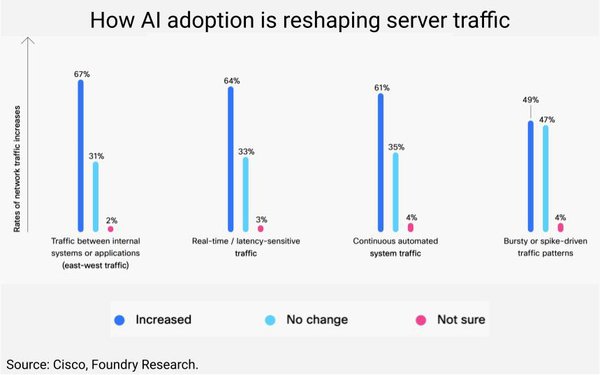
Cisco and Foundry Research released a report this week with data that represents a call to action amid the rising infrastructure and data challenges of
AI-driven media buying. It is based on a survey of more than 3,400 senior IT and networking decision-makers across 15 countries.
Rising network traffic due to AI poses a direct threat to ad
serving by causing latency that will break the time element of strict real-time bidding auctions. Network congestion and latency result in bid timeouts, which still occur, and unfulfilled inventory can degrade the user experience, forcing ad tech companies to
upgrade infrastructure or shift to edge computing.
advertisement
advertisement
The data suggests 73% of organizations will face network capacity constraints within two years. Many have reported their
network traffic had risen 34% in the past year. During the next 12 months, traffic is expected to increase 96%, and over the next three years it is expected to increase 209%.
Agentic
AI, generative AI, and physical AI such as robotics and AI-driven Internet of Things will drive the demand for network traffic, according to the data. All show no sign of slowing.
Jeetu Patel, chief product officer at Cisco, said the world has entered what he calls a "network supercycle," because the network and the internet has become central to all the
AI infrastructure worldwide.
Results from Cisco’s survey highlighted this shift, with more than 90% of those participating in the survey fearing financial and competitive risk if their
networking systems are not changed to adapt to AI-driven demand. Only 30% of the most aggressive adopters say they are fully prepared for projected AI growth across the network.
Security risks
also are a consideration, too. In Cisco’s survey, 80% expect security risks to further increase as AI adoption expands beyond generative use, and the rapid adoption rate of AI, agentic and
generative AI, has drastically increased the number of potential "entry points" in which cybercriminals can attack networks. As a result, 61% have put projects on hold until they gain greater
confidence in their network security.
The increase in network traffic has put Cisco in a positive position. The company expects to generate $4 billion in AI infrastructure revenue
from the supercycle effect Patel referenced. This will happen in fiscal 2026, and at least $6 billion in fiscal 2027. Its network pipeline, strong customer demand based on AI and strategic investments
in silicon, optics, security and AI gives Cisco in an opportunity to support the AI networking boom.