Each major platform
requires some type of transparency to enable viewers of ads to identify when they have been generated using artificial intelligence (AI). Some are driven by global regulations and laws, and others by
individual companies.
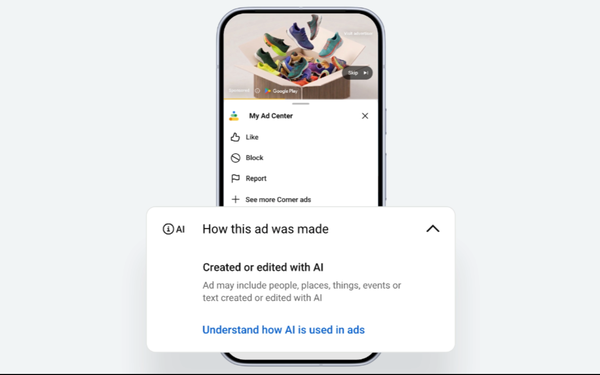
Google introduced additional transparency features across its advertising products this week to help people better understand the ads they
see as industry standards evolve.
The company added the "How this ad was made" section to the My Ad Center panel. It is accessible to all users globally, and can
be accessed by selecting the three-dot menu or info icon on ads across Search, YouTube and Discover to identify whether an ad was created or edited using AI.
New
York recently enacted a law mandating "conspicuous disclosure" when
advertisements include synthetic content generated by AI.
advertisement
advertisement
About 30 states have passed regulations requiring disclaimers in political advertising, but there is no comprehensive federal
law.
The updates build on Google's work to make AI and the way it is used more transparent.
Google has already embedded signals like SynthID into outputs
from its generative AI tools.
In 2023, Google introduced a requirement to disclose synthetic or digitally altered content in election ads.
When advertisers
use Google's generative AI advertising tools to create ads, the disclosure is automatically enabled. But when an ad is created with other types of tools, advertisers need to use a new control to
indicate whether AI was involved in its creation.
Meta, which updated its tagging system for Facebook and Instagram platforms earlier this week, requires a tag
within its "About this ad" settings menu.
This is triggered automatically if an advertiser uses Meta’s internal background or animation tools to create the ad or if the system detects
that the advertisement was made with AI.
Ads across Meta's platforms that were created using AI tools will include a disclosure in their "About this ad" element
that users can access by tapping the three-dot menu on any promoted post.
Advertising networks do not just take an advertiser's word for it, and require them to
follow special tracking protocols.
Many run AI scanners looking for physical and file abnormalities. This
includes checking for luminance discrepancies such as unnatural facial lighting, that are compared to the background and that differ from real camera-captured files.
Google's ad policies already serve as safeguards to share which technology and who stand behind an ad, as the company continues to prohibit misleading and deceptive ads, whether they
are created with AI or not.
TikTok's AI disclosure policy places the "AI-generated" tag directly over the video. On Friday, the company introduced new ways to
"transform how people share their creativity, discover new passions, and stay safe on our platform when used transparently and responsibly."
It did so by expanding TikTok's AI
literacy efforts with new educational resources and continued investment in trusted expert partnerships, testing "improved detection systems" that target accounts dedicated to posting AI-generated
spam that crowds out original creators, and strengthen AI transparency technologies and partnerships by joining the Coalition for Content Provenance and Authenticity (C2PA) steering committee.
C2PA technology is an open technical standard that reads the digital DNA of a video. As more creators explore AI, TikTok will continue to expand labelling
technologies and partnerships that help creators create responsibly, the company said in a blog post.
Microsoft also uses C2PA standard as its primary form of detection. The company
says that when an image or video is uploaded to the Microsoft Advertising suite, automated scanners immediately parse and read the file's background metadata.
As part of the process, if the
creative was generated or modified in tools like Adobe Photoshop, Midjourney, or DALL-E, Microsoft's system extracts cryptographic "Content Credentials" to track its origin and labels it
accordingly.
Each major platform requires some type of
transparency to let viewers of ads identify when they have been generated using artificial intelligence (AI). Much of it has been driven by global regulations and laws.
Ad
networks do not just take an advertiser's word for it, and require them to follow special tracking protocols.
Many run AI scanners looking for physical and file abnormalities such as checking for luminance discrepancies like unnatural facial
lighting and comparing it to the background, and that differ from real camera-captured files.
These ad policies serve as safeguards to share what technology and who stands behind an ad, as the
company continues to prohibit misleading and deceptive ads, whether created with AI or not.