Artificial intelligence (AI)
engines want different things from one brand compared with another.
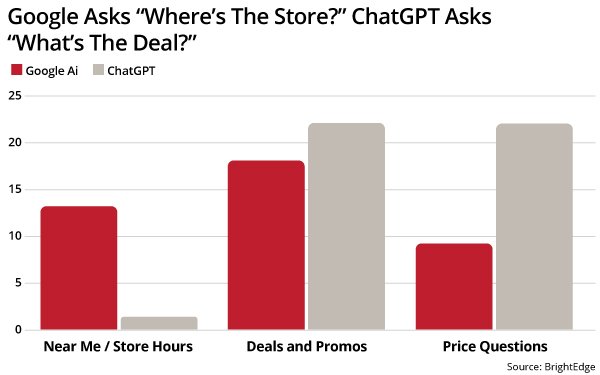
Google AI Overviews uses social platforms for local and availability signals.
Between 11% and 14% of its
transactional citations are near-me and store-hours prompts, according to data released this week by BrightEdge, an enterprise-level optimization and content performance marketing platform.
ChatGPT ignores the signals that tell the items or brands are local in nearly every query, the data shows.
Only 1% of AI engines do pay attention to local, especially when it comes to deals
-- which make up about 20% of transactions -- and pricing, which make up another 24% of transactional citations.
Google asks "Where's the store?" and ChatGPT asks "What's the deal?"
When Google AI Overviews searches Facebook or Instagram for a lower-funnel response that will answer a specific questions required to make a purchase
decision or finalize a choice, a major retailer is named or recommended in that same answer about 85% of the time.
advertisement
advertisement
These citations feed buying recommendations. The brands that
actually create the product list or citation comprise between 3% and 4% of the mentions.
Instagram is primarily used for prices and deals, while Facebook supports post-purchase activities such
as troubleshooting and returns, at a rate more than twice as much as Instagram.
AI engines cite Facebook and Instagram at the bottom of the funnel, but they use each platform for a very
different reason.
These citations end in buying recommendations, so when Google cites Facebook or Instagram in a lower-funnel prompt, about 85% of the time a major retailer is named or
recommended in that same answer.
According to BrightEdge, retailers are the answer and product brands are the question.
Users query a prompt about a specific product, and the engine
responds with where to buy it.
Product brands take just 3% to 4% of the brand mentions in these answers. If a company makes a product, the brand is in the prompt, but rarely in the
response.
"Each platform has a lane, so optimize accordingly," BrightEdge wrote in a blog post. "Instagram gets cited in the buying moment: deals, price, availability. Name the product, where
it's sold, and the offer in the caption text, including in influencer briefs."
In this process, the difference between Instagram and Facebook is that the latter is cited more frequently for
local and post-purchase, so the platform focuses on location.
It is important for brands to keep those pages current and add how-to content where queries ask how to get it done.