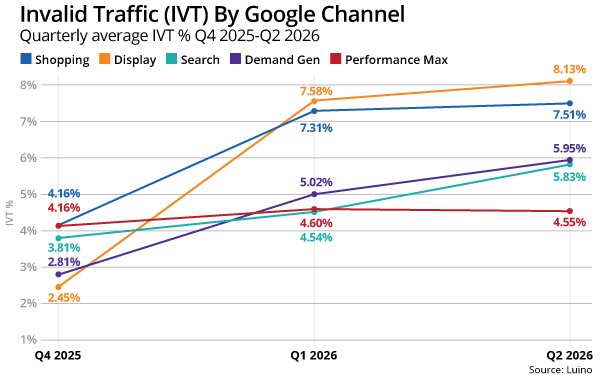
Invalid traffic (IVT) rates continue
to rise as advertisers adapt to complete automation of their advertising campaigns.
Industry benchmarks show global invalid traffic rates have surged. Some that were published earlier this
year forecasted IVT would reach up to 40% of all digital ad traffic by mid-2026.
The predictions were published by companies like Lunio, an ad-technology platform that helps advertisers and
publishers detect and block invalid traffic, and Anura, a cybersecurity software company.
Lunio CEO Nick Morley believes the increase in invalid traffic for retail is structural, meaning no
other media sector has moved more of its paid media into automated, machine-managed campaign types, he wrote in the report released Wednesday.
Now that Google AI Max decides where a growing
share of retail budgets are spent, every step trades a marketer’s control and visibility for reach.
advertisement
advertisement
Morley explains in the report that the biggest challenge is automation opening more
surface to bots, scrapers, affiliate abuse, and made-for-advertising inventory across more than 414 million clicks from retail ad accounts running on Google, Bing, LinkedIn, Meta, and native and
social platforms from October 2025 to June 2026.
On average, the IVT rate came in at 5% in Q1 2026 -- up from 4.18% in Q4 2025 -- and rose again to 5.54% in second-quarter 2026, the highest
percentage in the report’s dataset, according to data from Lunio.
The report determines that lost revenue approaches $750,000 each year when a retail business spends $5 million per year
on paid advertising, at an average cost per click (CPC) of $3.70, a mid-range benchmark for the premium and mid-to-high-average order rate analyzed in this report.
This is based on an IVT of
5% that could translate into roughly $250,000 in directly wasted advertising dollars spent annually, then factoring in what Lunio considers a conservative 3:1 return on ad spend (ROAS).
Across
Google’s search campaign dataset using AI Max, an optimization layer in Google Ads, accounted for 68% of all invalid clicks.
Google Performance Max campaigns during the analysis
accounted for 47% of all Google clicks, and combined with Shopping campaigns the two automated formats run most of Google’s ad volume.
Automated placements mean less visibility into
where budgets go, and fewer of the controls marketers once used to fend off low-quality inventory become invisible.
Retail brands showed an average 5% IVT rate in Q1 2026, up from 4.18% in Q4
2025, and rose again to 5.54% in Q2 2026, the highest percentage in the dataset.
Retail advertisers enter the peak 2026 holiday seasons, with invalid traffic at its highest recorded
level, in rate and absolute volume.
One awareness-focused upper-funnel video campaign recorded an average IVT of 81.33%, measured across more than 15,000 clicks, a sample more than large
enough to rule out statistical noise. Most clicks from that campaign never had a chance to convert, Morley wrote.
The role of AI accelerates this problem, with large language models (LLMs)
reducing the cost of generating sophisticated fraudulent traffic.
This means an agent that runs a synthetic browsing session, generates a plausible click pattern, and passes basic post-click
engagement signals can now be deployed for cents per session -- a staggering fact that is highlighted in the report.
The pressure will continue to mount. Google is rebuilding Search around
AI-driven query matching, handing more of the decision to searches that trigger an ad, as well as where those ads serve up.
Retail is adopting these campaign types more rapidly than any other
sector Lunio analyzed, and invalid traffic is following that adoption curve.