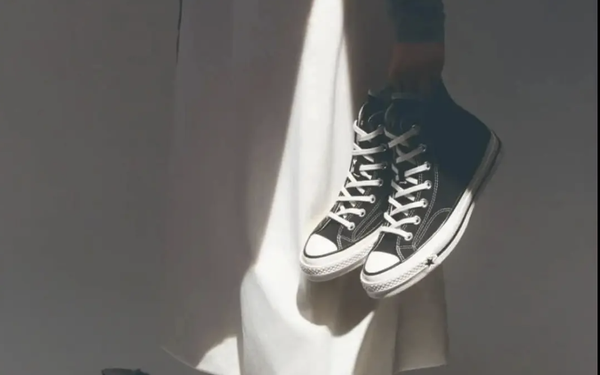
Converse, this week’s award
winner for marketing incompetence, may be hoping its now-infamous “KKK” ad will fall out of the news, but new data suggests its problems are likely about to get worse.
And to be
fair, things at Converse have been bad and getting worse for some time. Revenues have fallen more than 50%, from $2.43 billion in fiscal 2023 to $1.17 billion in fiscal 2026, with unit sales off 31%
this fiscal year.
Problems began almost the instant the image featuring K-pop singer Karina in a white skirt, dangling a pair of black Converse sneakers -- lit in a way that evoked the image
of a Ku Klux Klan hood -- first hit the company’s social media accounts.
Consumer outrage mounted, with Converse apologizing in statements emailed to media outlets (including
Marketing Daily.) And while it did not post the apology on its Instagram page, it did remove the image. “This should not have happened,” Converse said, “and we will do
better.”
advertisement
advertisement
What the Averages Hid
Zappi, a consumer insights company, tested the image. The company showed the ad to a group of 250 human consumers in an Instagram
feed environment. Almost a third of them, unprompted, connected the image to lynching, the KKK, or racist imagery. And one in four called the ad offensive, unpleasant or disturbing.
A careless
reading of that data might lead someone to sign off on the image, since two-thirds of viewers didn’t see a problem.
That’s a mistake, says Nataly Kelly, Zappi’s CMO, who
notes that often, averages can bury the most important findings: Among Black respondents, 46% saw the KKK association.
So did 42% of 18-to-34-year-olds, and women were also more likely to spot
a problem. And 42% of respondents who saw the lynching association said they were less likely to consider buying Converse.
For a brand that’s already bleeding, that is bad news.
Carelessness or neglect can be perceived as intention. While it’s hard to fathom Converse would create such an ad intentionally, many consumers did read it that way. And it’s a moment
of heightened awareness, with an increase in lynchings in the U.S.: Members of the House of Representatives say there have been 10 reported hangings of Black people, with 59 members calling for
stepped-up federal investigations.
"There are gradations of intentionality,” says Mark S. Robinson, author of “Pitch Black: The Best Black Ads of the Last 50 Years” and
45-year ad industry vet. “What is deliberate and intentional is obtuseness. You can be recklessly ignorant."
Converse didn’t help its cause with such a vague “We'll do
better” apology, Robinson says. “To me, that immediately provokes the question: Well, what will you do?… Give me something concrete.”
Other industry observers see
clear process failures. Sam Gauchier, an independent PR consultant, can imagine how it happened, analyzing any given image, element by element, in this case, the white skirt, the styling, the
brand’s star projection. “But consumers don't receive these elements individually. They receive a flattened image," she tells Marketing Daily.
What didn’t happen, she
says, is for someone in the process to say, "What is the worst possible interpretation our consumers can get from this?"
In Converse’s case, she notes, that had an even more damaging
impact. Not only did some consumers make the lynching-related assumption about this image, but they also found another Converse ad just a few weeks earlier. That one, which appeared on
Converse’s Malaysia Instagram for the Converse x Palmes campaign, showed a man climbing a ladder into a tree, a pair of Converse dangling above him, as another man looked on.
"A
controversy can not only change how consumers interpret what you do next, but they also go back and reinterpret what you already did," she says. "A hundred years of brand equity does not give you
resilience, and it shouldn't give you complacency."
The buck stops nowhere
Plenty of CMOs are likely shrugging. In an ecosystem where creators, influencers, international
licensees and even AI are cranking out almost infinite content, who could possibly be responsible for every image? In that scenario, the buck stops nowhere. Anarchy ensues.
"My take is this is
a process failure," Kelly says, adding that there’s no reason not to test. (Kelly is admittedly in the business of selling such testing.) “Even if your budget has shrunk, you can still
test with AI. And the fix isn't to spend more. The fix is that if any respondent in any market names violence or hate symbolism, that image should not ship until a human evaluates it."
There
are multiple lessons here. For Gauchier, it’s as simple as empowering at least one person in every approval process to be the devil’s advocate, even if it means scrapping an expensive
asset. For Robinson, it calls for something bigger. He notes Nike has a deep bench of Black creatives. “I would say 'I need some of those folks over here at Converse today…to be a check
on the rest of you idiots who allowed this to happen.”
Idiocy, maybe malpractice, or just a failing brand with a shrinking budget? Nike’s corporate filings reveal a 39% drop in
Converse’s demand creation expense, "primarily due to lower brand marketing expense," even as Converse’s free fall continues.
"A brand that is not doing well keeps
getting less and less investment,” Kelly notes. “The budget for testing goes down. Key roles are eliminated. And that is when these types of breakdowns happen."