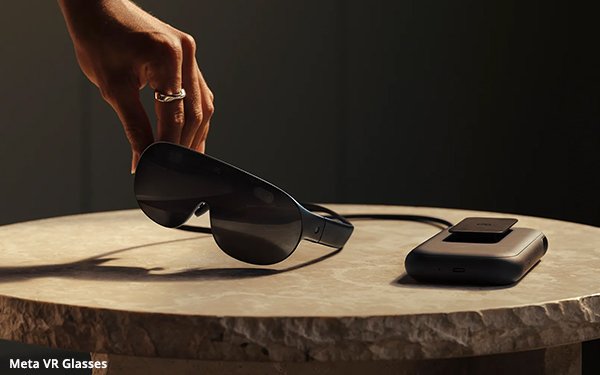
As lawsuits and privacy concerns plague Meta’s wearables
business, the tech giant is planning to launch a new pair of AI-powered virtual reality glasses designed to rival similar products from competitors like Apple.
During Meta’s Connect developer conference on Wednesday, CEO Mark Zuckerberg debuted a new alternative to its Quest-branded VR headsets, introducing a product that is lighter and less
expensive than competing VR wearables, such as Apple’s Vision Pro and Snap’s recently launched Specs.
Weighing 100 grams -- over 400 grams lighter than Meta’s prior VR Quest model -- the VR glasses resemble a pair of retro sunglasses, with a wire connected to a pocket-sized puck that
powers the device via a Snapdragon Reality Elite processor with 128GB of storage and 12GB of RAM.
advertisement
advertisement
The battery itself is
expected to power up to three hours of media playback on what Meta calls an “Infinite Display” with two cameras for color passthrough, allowing users to continue viewing the world around
them.
Meta’s VR glasses are controlled by the user’s hand gestures, as well as eye-tracking
cameras.
Along with live sporting events, virtual workspaces, and VR-enhanced movies, Meta is focused on
video games and the gaming community.
While the company’s prior VR headset-capable gaming platform Horizon Worlds failed to onboard players, the VR glasses will launch this
spring with 75 built-in games, as well as the Quest app catalog.
Compared to the Vision Pro’s $3,699 cost,
Meta’s VR glasses will cost $1,299.
The company is still planning to develop new iterations of its full VR headset, as well as AR glasses, similar to Snap’s recently launched Specs model.
Meta’s VR glasses also include its Muse AI-agent, allowing users to command the product with their voice.
As the AI race intensifies, the company is integrating Muse into more of its consumer-facing products, including its camera-less smart glasses and the Muse Charm, the company’s
first personal AI agent device.
However, by introducing new wearable products, Meta may also be trying to overshadow the ongoing
backlash against its smart glasses, which are being referred to by consumers as “pervert glasses” and “creep glasses” for alleged invasions of privacy.
Last week, over 70 people who used Meta’s smart glasses sued the company for deceptively capturing footage of themselves and family members “undressing, going to the bathroom,
having sex and entering passwords,” according to The Los Angeles
Times.
The lawsuit, filed in a federal court in Northern California, also accuses Meta of
fraud and false advertising, while also violating consumer protection laws across multiple U.S. states.
Meta’s smart glasses have also been banned in
courthouses throughout various states and countries, including England, Wales, and New
York.
During its Connect event, the company addressed user’s privacy concerns, announcing a
new Private Processing approach to Meta AI, designed to process user information gathered by its wearables within “confidential virtual machines,” allegedly barring Meta from accessing the
information.
Moving forward, users will also have the ability to opt-out of having their visual data from AI glasses used for training the company’s AI
models.