Google rolled
out two features Wednesday designed to add control and flexibility to a marketer's ad spend.
The features -- explained as "controls" during a briefing with reporters -- become available today
globally across Google's Search, Shopping, Performance Max, and soon will be available on its Demand Gen platforms.
Tal Akabas, director of product management at Google Ads, said the features
are optional, adding that if advertisers do not want to use them they must opt-in for most campaign types.
The only exception is Google Display Network in Search campaigns.
"Many
advertisers have already opted in to the search partner network or display network on search, and have concerns on how the spend fluctuate on those channels," he said, adding the hope is it will
performance spend more predictable for advertisers.
advertisement
advertisement
Akabas also said the team is looking into breaking out controlled spend for different types of search and AI-based experiences.
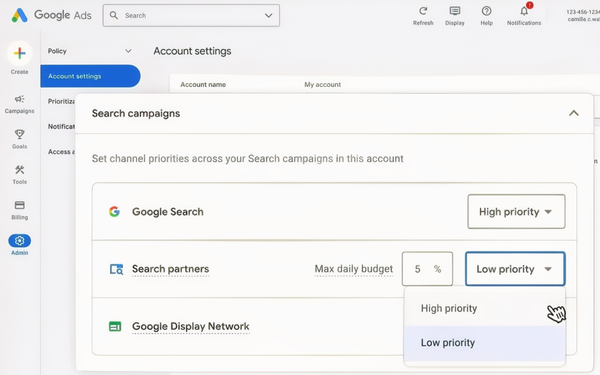
For now, the controls are focused on "channel prioritization" and "budget allocation," which work together and are intended to provide advertisers with more precise and custom control over their
budgets, rather than acting as an "all-or-nothing" opt-out out feature.
Setting a budget and channel prioritization allows marketers to decide where the money flows first by
categorizing inventory as “high priority” or “low priority” for specific channels or channel groupings.
When configured, campaigns will fully fund high-priority channels
within their target when using Target CPA or Target ROAS, before allocating the remaining budget to lower-priority channels.
For example, on Search campaigns, marketers can set Google Search,
Search partners, and Google Display Network into different priority levels depending on what they value. '
In Performance Max and Demand Gen campaigns, Google surfaces such as Search, YouTube,
Maps, Gmail and Discover are prioritized together as "Google channels.”
Flexible budget allocation focuses on the channel level. When a channel is set as "low priority,"
advertisers can specify a maximum percentage of their daily budget to stay within their desired boundaries on those channels.
The tools will focus on keeping the marketer's ad spend on those
channels within that limit.
Marketers that have historically opted out of search partners and the Google Display Network can use this new lever to test these networks with more confidence and
clearer limits, rather than turning them off entirely.
Google will shutter the current spend allocation setup for Search campaigns with the Google Display Network turned on starting in
February 2027.
Advertisers can keep their current allocation by setting the Google Display Network to “low priority” with a 50% budget allocation.