AI has opened more sophisticated methods for digital
marketers to reach intended audiences with targeting signals and data that were once unattainable.
For advertisers, the goal is to run media strategies and cross-channel campaigns with
assistance from artificial intelligence (AI) systems that can understand a brand, its products, and what matters most to its target audiences.
These insights help reveal motivations for
buying, objectives, and emerging themes that may not always be apparent in traditional performance data.
When they are injected into Google Performance Max through search themes and audience
signals, they help the algorithm explore more relevant queries and reach high-value users more quickly, according to Frédéric Derian, director of product management at agency
Jellyfish, part of The Brandtech Group.
advertisement
advertisement
"This leads to higher clickthrough rates, stronger conversion rates, and incremental revenue uplift, as demonstrated in early deployments in the
U.S. market across fashion, accessories and B2B industries," Derian said.
Jellyfish gains insights from the Google Ads platform Performance Max, and by using insights from large language
models (LLMs).
With its "Share of Model" tool, Derian said, Jellyfish is the first company to use brand perception from AI models and assistants like Gemini and ChatGPT to automatically
optimize ads.
"Share of Model" launched in late 2024, but advancements in the tool can now turn AI-driven brand-perception analysis into direct optimizations for Performance Max campaigns.
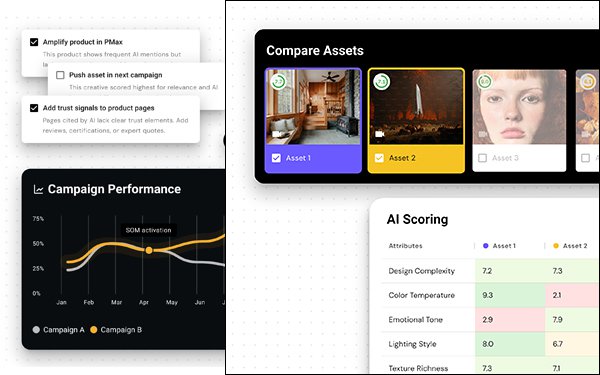
In practice, the technology identifies gaps between how AI models perceive a brand and the brand’s advertising messages, and automatically generates Search Themes that are aligned with
a user's real intentions.
Traditionally, optimization of ads running on Google's platform relies on performance history, creative assets, product feeds and first-party data.
Using
this approach, Jellyfish introduced another data layer -- the way AI models such as Gemini, ChatGPT, Llama and Claude understand and have a conversation about a brand.
"This goes beyond
keywords," Derian said. "It is about aligning campaigns with the themes, attributes and needs that AI identifies as meaningful for consumers."
Rather than influence answers from LLMs,
Jellyfish's tool uses what LLMs already understand to improve media performance.
MediaPost asked when developers realized this was possible. Derian said it occurred to them following
discussions with Google's research and development teams.
"We were able to update signals for Performance Max, search themes and soon audience, programmatically," he said.
Jellyfish's developers then built an algorithm that became consistent enough to provide a stable, measurable perception of brands.
Embedding the models made it possible to compare this
perception with existing Google Ads assets.
This combination allowed developers to build a reliable link between AI-driven insights and Performance Max.
A direct connection between
brand perception and advertising performance through four key steps supports the tool.
The four steps include perception analysis, identifying the opportunity, generating new search themes and
being able to integrate the search themes directly into Google Ads via APIs.
MSC Direct, an industrial distributor, used the Share of Model to identify search opportunities for advertising
algorithms that were previously not visible. This resulted in a revenue increase of more than 45% on optimized asset groups and an average of more than 50% boost in return on ad spend (ROAS) during a
30-day test period without increasing the budget.
Other brands, mostly in the lifestyle sector, have reported similar results and have seen measurable improvements in both relevance and
qualified traffic within just a few weeks, the agency said.