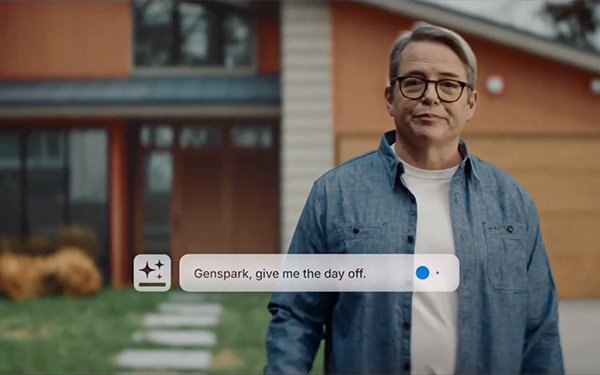
While the media buy of a Super Bowl ad typically
starts at $8 million, a full campaign could cost anywhere between $16 million and $29 million to create.
Ads tell consumers so much about a brand, but analyzing Google search data can tell a
brand so much more about consumers.
Sixty-seven Super Bowl advertisers this year sought to achieve the highest return on attention they could from their ads, but AI search engine startup
Genspark dominated the bunch with a 5,852% search spike, nearly tripling that of established brands.
It showed that brand unfamiliarity can still drive higher engagement than household
names.
The brand outpaced household names by nearly 1,000 percentage points with an ad featuring Matthew Broderick getting into his Ferris Bueller persona, urging viewers to let AI handle
their work and take Monday off.
advertisement
advertisement
Audio Visual Nation (AVN), which staffs large events, ran a study to analyze Google search data for all 67 Super Bowl advertisers to identify the brands that
achieved the highest return on attention. AVN analyzed Google search traffic for all using Google Trends to measure audience engagement and curiosity following the game.
The top brands
left audiences asking "what is that?"and generated higher search spikes than established names -- even at $266,000 per second, the research shows.
Curiosity is what justified the
multimillion-dollar spend, according to James Grifo, owner and CEO of Audio Visual Nation.
“At $266,000 per second, the real measure of success is whether viewers reach for their
phones after your ad runs," Grifo said. "The top performers created that knowledge gap [and] audiences wanted to understand what they had just seen."
Audio Visual Nation created a baseline for
the analysis in January 2026, then tracked peak interest during game week, February 2- February 9, 2026. Researchers said the results identified the ads that drove genuine curiosity and
engagement.
Average Interest represents the daily Google search interest for each brand, calculated using Google Trends data. All daily interest values within this period were divided by the
number of days with available data.
If no data points existed, Average Interest was recorded as 0.0. Searches were conducted using keyword-based queries rather than Google Trends "Topic"
classifications, meaning results may include broader or ambiguous search intent.
The data revealed a pattern. Search spikes did not necessarily come from brands or products that consumers were
already familiar with. Genspark's ad had an average interest rating of 2, while Cadillac F1's ad also had an average interest rating of 2, but its traffic rose 4,800%.
Cadillac’s
ad featured a desert setting and JFK's famous “We choose to go to the Moon” speech. As the first new F1 team since 2016 and the first American-registered team in a decade, Cadillac
positioned itself as “America's team” entering a European-dominated sport. The new car designed to compete in the 2026 Formula One World Championship will make its debut in the 2026
season.
Hellman’s ad came in with an average interest rating of 3, and search traffic increase of 2,774%.
Budweiser had an average interest rating of 5, with a search traffic
increase of 2,023%. Svedka had an average interest rating of 6, with a search traffic increase of 1490%.
Kinder Bueno, Lay’s, Oakley Meta, Liquid Death, and Telemundo followed with
different interest ratings and search traffic increases.
The data shows that brands need to know consumers more fully.
Share of search serves as a proxy for market share, even if
consumers don't know your brand.