Consumers consider trust to be one of the most important
factors when considering loyalty to a branded chatbot regardless of its maker — Google, OpenAI, Microsoft, Amazon or another — and some feel uneasy about the speed at which these
companies release the technology because it does not give them a chance to comfortably adapt and adopt.
Research and measurement company Cint released a report this week focused on the
impact of generative AI adoption on average consumers and how comfortable people are asking an AI chatbot for advice, as well as entrusting it with managing processes and events.
About
1,000 respondents in the United Kingdom and the United States participated in the study, which was conducted in late January and early February 2026.
Respondents were asked to rate the
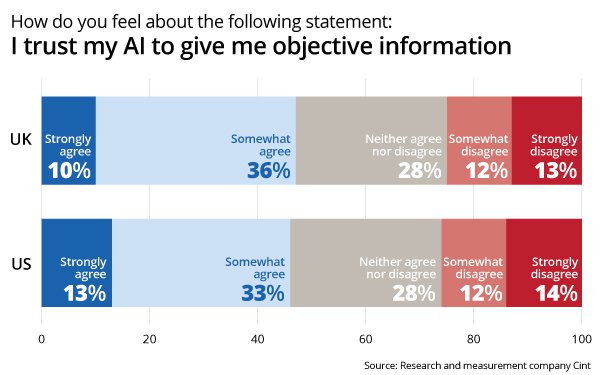
trustworthiness and objectivity of generative AI results. When it comes to trustworthiness, U.S. respondents were slightly more trusting of the information served by large language models (LLMs) and
other generative AI products, compared with their U.K. counterparts.
advertisement
advertisement
A significant minority — roughly one-quarter of the participants in each country — 28% in
the U.K. and 26% in the U.S. -- also held the opposing view.
U.K. respondents were more likely to allow an AI product to oversee their personal financial planning than asking the LLM plan a
romantic date, and were uneasy turning to AI to help make bigger life decisions, such as choosing a school for a child, or relocating did not prove popular.
Similar results were found in the
U.S., where respondents were willing to delegate financial planning and vacation booking to AI, but preferred to personally manage bigger life decisions such as education and relocation.
Forty-six percent of respondents believe AI services provide unbiased and objective information although the data comes from websites across the internet, compared with the opposing view for 25% of
U.K. and 26% of U.S. survey respondents.
Not everyone uses AI chatbots. Data from the survey showed similar use patterns across the U.K. and the U.S. Nearly one-third said they use AI daily,
while one-fifth said they do not use any kind of AI daily. People mostly use AI as daily assistants, 39% in the UK and 37% in the U.S., rather than rely on traditional search engines for answers.
About one-quarter of those surveyed said they use AI to find recipes and find meal prep ideas, as well as general cooking tips. AI is being used to assist respondents for responsibilities ranging
from parenting to drafting social media posts.
In both countries polled, 27% of respondents said they are either extremely or very concerned about the use of AI in advertising, and an
additional 26% of those in the U.K. and 29% of those in the U.S. noted a moderate level of concern when it comes to AI-assisted advertising campaigns.
Just one-fifth of U.K. respondents and
around one-quarter of those in the U.S. indicated no concern at all around this topic.
In terms of brand perception, the verdict was surprisingly consistent: knowing an ad is AI-made does not
significantly change how people feel about the brand behind it. Among U.K. respondents, 7% say AI-made ads would give them a much more positive perception of a brand, while 15% say the opposite.
However, the majority remained unmoved, with 42% taking a neutral stance. U.S. results were nearly identical, with 11% more positive, 14% more negative, and 44% unaffected.