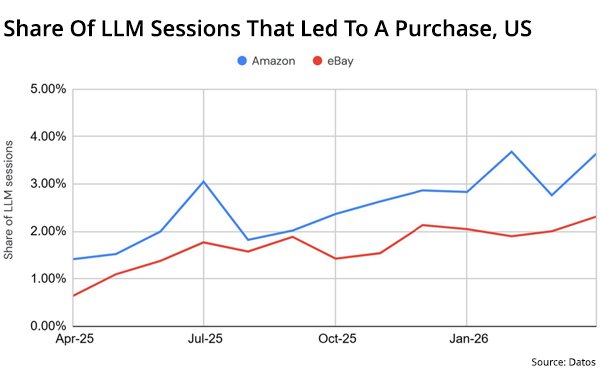
AI-referred purchases --
transactions that happen because an artificial intelligence (AI) tool recommended the products to users -- continue to rise. The number of these AI-driven sales is twice as high as a year ago, at
least for Amazon, according to recent data.
Rather than searching manually on the website, more consumers are asking AI tools such as Google Gemini, OpenAI ChatGPT, Anthropic Claude and
Amazon Rufus for recommendations, and then buying the suggested items.
advertisement
advertisement
Electronic records tracking the exact path a user clicks online reflect the change, according to data from Datos, a
Semrush company owned by Adobe.
Eli Goodman, president at Datos and vice president of product sales at Semrush, supports the idea that AI continues to play an important role in
recommendations.
The data shows that AI traffic has grown between 45% and 60% during the period analyzed, and remains approximately one-tenth the volume of traditional search.
AI
references reach approximately 3.6% in the U.S. and 4.6% in Europe in early 2026, according to the report, titled "How AI is Reshaping Customer Journeys."
Analysis draws on Datos' U.S.,
European Union, and United Kingdom clickstream panels, tracking real desktop consumer behavior for the one-year period between April 2025 and April 2026.
Analysts looked at consumer journeys
across consumer electronics, healthcare, beauty, automotive, SaaS, luxury goods and ecommerce.
OpenAI ChatGPT remains the most-used AI platform, but its lead continues to narrow, reaching
approximately 38% usage share in the U.S., 44% in the EU and the U.K. by April 2026.
Google Gemini has roughly tripled its share during the same period, reaching 19% in the U.S. and 21% in the
EU and the U.K.
AI users interact with AI on approximately 1 in 4 days per month, between 26% and 27% in the EU, and about 26% in the U.S.
The report includes analysis of real consumer
journeys across categories such as Samsung TV, Wegovy/Ozempic, Dell gaming PC and Sephora, and illustrates how AI now appears at multiple stages of the purchase lifecycle, from
initial research through to post-conversion reassurance.