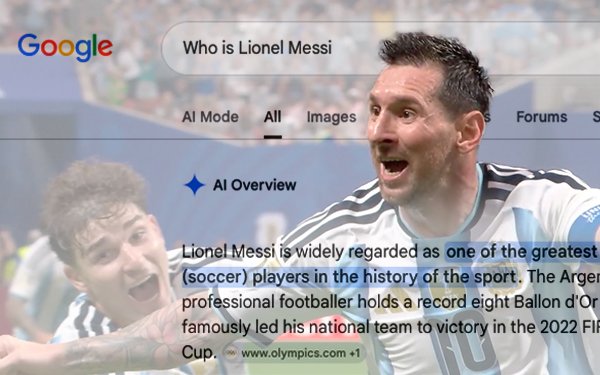
Google achieved a World Cup win of its own this
week during the international soccer tournament.
It occurred based on the number of queries immediately following when Argentina scored the winning goal in its comeback victory against Egypt
in the World Cup Round of 16 match.
Argentina completed a late comeback, with Cristian Romero scoring before Lionel Messi sealed the win.
The moment surpassed all prior Google Search
uses in the company's history, which began in September 1998.
“Google Search broke all prior usage records and saw its highest usage in history right after Argentina scored their winning
goal in yesterday’s match!” Nick Fox, senior vice president of knowledge & information at Google, wrote on X this week. “Great to see the global excitement for the World Cup...
can't wait for the semis and final!”
advertisement
advertisement
The measurement is based on the number of search queries per second that occurred on its search engine during the game that occurred immediately
following Argentina's third goal.
Statcounter’s GlobalStats numbers put Google’s worldwide traditional search engine market share worldwide at 91.25% in June 2026. Bing followed
with 4.68%.
When data models expand the “search” definition to include stand-alone AI platforms as part of the total digital-query volume, Google's share drops to roughly 80%,
according to the agency First Page Sage.
The First Page Sage Q2 2026 Report states that adding
stand-alone AI assistants into the total query-volume calculation drops Google's overall digital-query share to roughly 77% to 80%. In that same model, OpenAI's ChatGPT captures roughly 17% to 17.9%,
with other alternative AI engines securing the remainder.
So, while Google still controls nearly 90% of the traditional search market, AI engines like OpenAI ChatGPT are gaining ground and
taking part of the total market share.
First Page Sage reported that Google still dominates the large language model (LLM) sector, with approximately 77% of global digital queries, but ChatGPT
reached 1 billion monthly active users in May 2026 and holds about 17.9% of total digital queries, presenting the "greatest threat to Google’s market dominance" in the past 20 years.
Google Gemini has scaled rapidly to 750 million monthly active users, driven by native integration across Google Search, Android, and Workspace and positioning it as ChatGPT’s most
significant long-term competitor.
Although it had fewer total users than Google, ChatGPT's session duration is substantially higher, suggesting deep user engagement. This also means that ads
get a longer view by users, which could pull in more advertisers in the long run.