Defining what specific
content or programming media agency executives are buying on connected TV (CTV) and streaming platforms remains an issue.
Research continues to show that a "Deal ID" -- a string of numbers and
characters that comes from a supply-side platform or publisher -- doesn’t offer what "authenticated" or “content” ID signals provide. The latter comes directly from a publisher and
confirms what is on the screen.
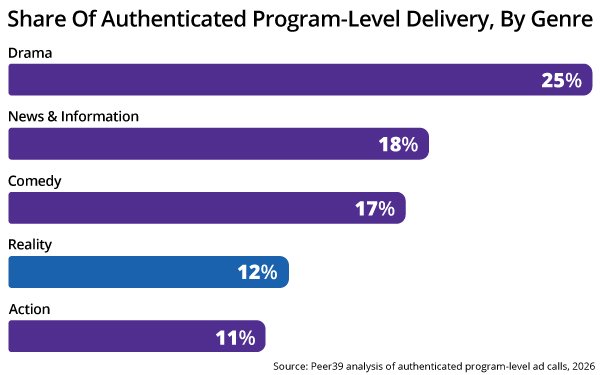
This can mean uncertain results for media agencies, according to research from Peer39, a data/intelligence platform for programmatic advertising.
It
says this can result in up to 25% delivery of “fake content” or 23% of "sensitive content." This is in comparison to better results for authenticated content, which scores a low 2.2% and
6.5%, respectively.
advertisement
advertisement
Peer39 says “authenticated” IDs can deliver better results, with up to 32% revealing the "known channel" -- versus 4.5% for knowing what is on the screen when
buying video on the open exchange.
It added that removing the opaque packaging layer and replacing it with authenticated pre-bid controls did not sacrifice quality for efficiency, but
delivered both.
This includes 67% lower effective CPMs (cost-per-thousand) and 76% more impression volume.
“Publishers are not, for the most part, deliberately falsifying content
signals,” says Peer39. “The problem is more structural: the programmatic supply chain was engineered to move impressions at scale, and signal fidelity was never a gating condition for
participation.”