The Association of National Advertisers presented an
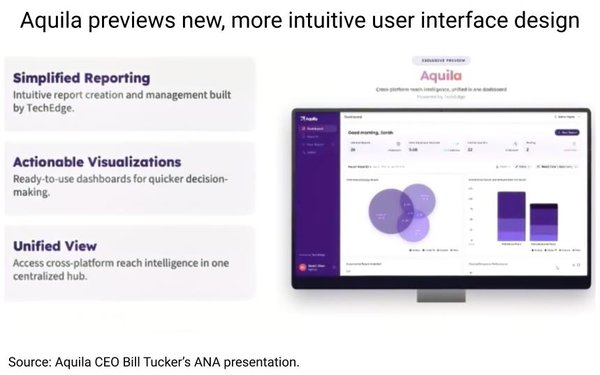
update of its ambitious Aquila cross-media measurement service at its ANA Measurement & Analytics Conference in Chicago -- unveiling a preview of its new-and-improved user interface, projecting
the number of big clients using it will more than double to 70 within the next year, and revealing plans to expand beyond its initial mission of deduplicating the reach and frequency of linear TV vs.
CTV, streaming and online video to also include all other digital advertising formats, including audio, static display, etc.
"It absolutely supports video, but really the ambition is for it to
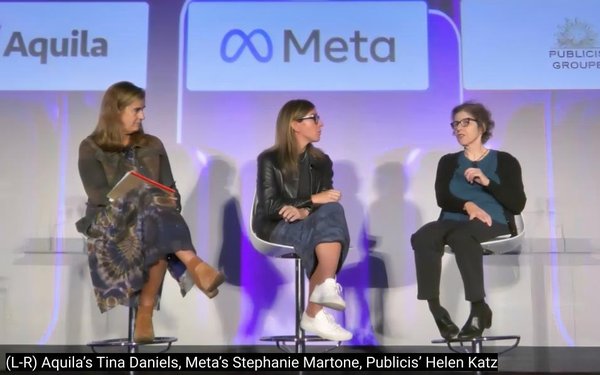
be fully across all media," Stephanie Martone, global industry initiatives lead at Meta, explained during a panel discussion Tuesday at the conference.
Meta, along with Google, Amazon and
TikTok, is one of the primary initial financial sponsors -- as well as proprietary data providers -- to Aquila, which has been pushing hard to get a critical mass of ANA members to pay for the
service.
advertisement
advertisement
During a brief update presentation leading into the panel discussion, Aquila CEO Bill Tucker announced that Aquila now has 28 ANA member advertisers paying for the service, and
projected it will more than double to 70 by next year.
He also updated the business model, noting that Aquila's customers "either pay for the platform directly or we'll move them into a
fractional advertising contribution, which is a payment on the back-end of media."
That appears to be refinement from a presentation Tucker made in May when he first announced a "fractional
advertising contribution" payment model for Aquila, which I characterized as an ironic "ad tax" -- ironic, because the ANA historically has been fighting so-called non-working media ad-tax costs, and
effectively would be adding its own on the back-end of media buys using Aquila data.
Based on my read of his description Tuesday, I take it that Aquila customers have the option of paying for
the data up front via some sort of licensing or SaaS payment arrangement, or paying for it on the back-end based on media buys processed through its pipeline provider Mediaocean.
As for
broadening Aquila's cross-media measurement capabilities, Meta's Martone said: "Speaking as Meta, we put all of our inventory in there across all of our services, our formats and it is a personal
passion of mine to get others into the system, whether it is audio, display, DSPs [demand-side platforms], virtual media networks. Like you name it, we really want this to be a big tent, where it's
not just video-only."
"And it really has to be," added Publicis Media Executive Vice President-Research Helen Katz, "ultimately because we're measuring consumers here. We are measuring what
media they are using and they're not differentiating between, 'Oh, this is display and this is podcast, you know. And this structure will help enable us to do that."
"We have gotten off to a
really strong start, because we are a place where marketers can compare YouTube, Meta, television. That is kind of our beta offering right now," confirmed Aquila President-COO Tina Daniels, adding:
"TikTok [and] Amazon soon to be integrated this fall, along with connected TV."
Katz's observation that the goal of Aquila is more consumer-centric than it is media-centric is an important
insight and one that potentially recalibrates the way advertisers even think about reach and frequency across media, because instead of aggregating disparate media-measurement sources to build a
unified view of consumer media exposure, it will be working with media source data -- at least in terms of the log file data being contributed directly be its digital platform partners -- to form an
aggregate view of consumer media usage vis a vis Aquila's "VID" (virtual ID) methodology.
In reality, it also is integrating, and aggregating, data from syndicated measurement providers --
Comscore for linear TV and Samba for CTV -- but the holistic consumer-centric view across media is something the ad industry had typically referred to as one of its "Holy Grails" when it comes to
media measurement.
To date, the Aquila team, as well as its participants, have eschewed the notion that the data it generates will ever be used as advertising marketplace "currency," but that
it will be used at a higher level, helping marketers -- there agencies, the media and others -- understand the fundamental reach and frequency of ads across media so they can reduce excess frequency
and focus on achieving the most cost-effective unduplicated, or "incremental" reach in there media plans and buys.
That said, both Aquila's Tucker and the panelists said one of the longer-term
goals is to feed Aquila's data into various marketing mix models, and other forms of ROI analytics that could have a profound impact on the share of advertising budgets being allocated to various
media.