Commentary

Aquila Poised To Cross Even More Media: Display, Audio, 'You Name It'


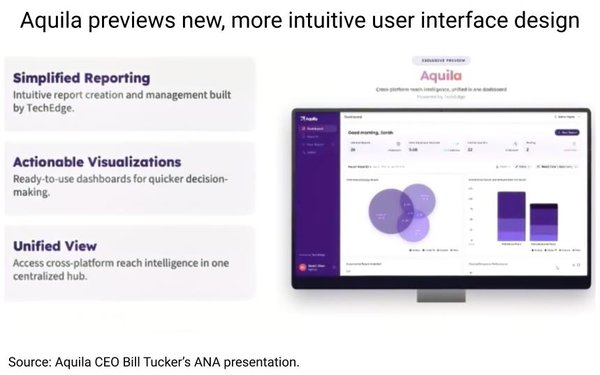
The Association of National Advertisers presented an update of its ambitious Aquila cross-media measurement service at its ANA Measurement & Analytics Conference in Chicago -- unveiling a preview of its new-and-improved user interface, projecting the number of big clients using it will more than double to 70 within the next year, and revealing plans to expand beyond its initial mission of deduplicating the reach and frequency of linear TV vs. CTV, streaming and online video to also include all other digital advertising formats, including audio, static display, etc.

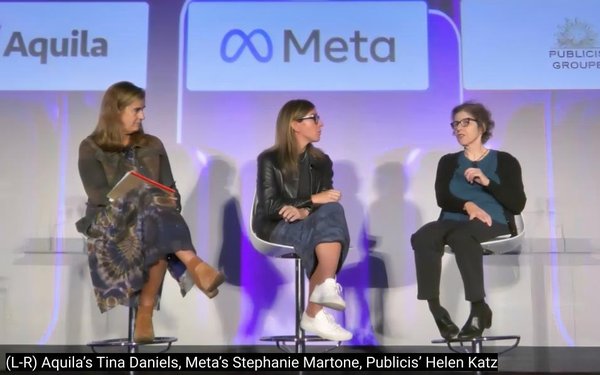
"It absolutely supports video, but really the ambition is for it to be fully across all media," Stephanie Martone, global industry initiatives lead at Meta, explained during a panel discussion Tuesday at the conference.

Meta, along with Google, Amazon and TikTok, is one of the primary initial financial sponsors -- as well as proprietary data providers -- to Aquila, which has been pushing hard to get a critical mass of ANA members to pay for the service.

advertisement

advertisement

During a brief update presentation leading into the panel discussion, Aquila CEO Bill Tucker announced that Aquila now has 28 ANA member advertisers paying for the service, and projected it will more than double to 70 by next year.

He also updated the business model, noting that Aquila's customers "either pay for the platform directly or we'll move them into a fractional advertising contribution, which is a payment on the back-end of media."

That appears to be refinement from a presentation Tucker made in May when he first announced a "fractional advertising contribution" payment model for Aquila, which I characterized as an ironic "ad tax" -- ironic, because the ANA historically has been fighting so-called non-working media ad-tax costs, and effectively would be adding its own on the back-end of media buys using Aquila data.

Based on my read of his description Tuesday, I take it that Aquila customers have the option of paying for the data up front via some sort of licensing or SaaS payment arrangement, or paying for it on the back-end based on media buys processed through its pipeline provider Mediaocean.

As for broadening Aquila's cross-media measurement capabilities, Meta's Martone said: "Speaking as Meta, we put all of our inventory in there across all of our services, our formats and it is a personal passion of mine to get others into the system, whether it is audio, display, DSPs [demand-side platforms], virtual media networks. Like you name it, we really want this to be a big tent, where it's not just video-only."

"And it really has to be," added Publicis Media Executive Vice President-Research Helen Katz, "ultimately because we're measuring consumers here. We are measuring what media they are using and they're not differentiating between, 'Oh, this is display and this is podcast, you know. And this structure will help enable us to do that."

"We have gotten off to a really strong start, because we are a place where marketers can compare YouTube, Meta, television. That is kind of our beta offering right now," confirmed Aquila President-COO Tina Daniels, adding: "TikTok [and] Amazon soon to be integrated this fall, along with connected TV."

Katz's observation that the goal of Aquila is more consumer-centric than it is media-centric is an important insight and one that potentially recalibrates the way advertisers even think about reach and frequency across media, because instead of aggregating disparate media-measurement sources to build a unified view of consumer media exposure, it will be working with media source data -- at least in terms of the log file data being contributed directly be its digital platform partners -- to form an aggregate view of consumer media usage vis a vis Aquila's "VID" (virtual ID) methodology.

In reality, it also is integrating, and aggregating, data from syndicated measurement providers -- Comscore for linear TV and Samba for CTV -- but the holistic consumer-centric view across media is something the ad industry had typically referred to as one of its "Holy Grails" when it comes to media measurement.

To date, the Aquila team, as well as its participants, have eschewed the notion that the data it generates will ever be used as advertising marketplace "currency," but that it will be used at a higher level, helping marketers -- there agencies, the media and others -- understand the fundamental reach and frequency of ads across media so they can reduce excess frequency and focus on achieving the most cost-effective unduplicated, or "incremental" reach in there media plans and buys.

That said, both Aquila's Tucker and the panelists said one of the longer-term goals is to feed Aquila's data into various marketing mix models, and other forms of ROI analytics that could have a profound impact on the share of advertising budgets being allocated to various media.
10 comments about "Aquila Poised To Cross Even More Media: Display, Audio, 'You Name It'".
Check to receive email when comments are posted.
  1. Frank Zazza from iPause Ads, September 30, 2026 at 1:02 p.m.

    Hey Joe, I believe Aquila’s expansion across media is another important step toward a more unified and transparent measurement ecosystem. Understanding reach and frequency across platforms is essential. However, the next evolution will be connecting that exposure to verified consumer actions and outcomes. 

  2. Ed Papazian from Media Dynamics Inc, October 1, 2026 at 10:37 a.m.

    But what are they going to use to determine an "impression" --let alone the ad reach---for audio or a  display page in a newspaper, magazine or website?

    And is it a real problem from a media planning--not buying---standpoint that is being dealt with? Does it really matter if a media planner estimates that a certain media mix may generate a 65% reach and 6.6 frequency  per month next year and an actual tally finds that the "correct" numbers were 63% and 6.9.

    A similar enterprise has been operating in Great Britain for some time and what they have found is that it is not used very often because once a basic layer of tabs is performed the results become highly predictable---which is what media planners have  found for TV over the years. 

  3. Joe Mandese from MediaPost Inc., October 1, 2026 at 10:42 a.m.

    @Ed Papazian: Well, if you read what Helen Katz said, the whole point is NOT looking at advertising exposure from a media "impressions" level, per se, but looking at it from a consumer POV: "We are measuring what media they are using and they're not differentiating between, 'Oh, this is display and this is podcast, you know. And this structure will help enable us to do that."

  4. Ed Papazian from Media Dynamics Inc, October 1, 2026 at 10:49 a.m.

    Joe, that's fine, but the main users will be advertisers and I suspect that they will be mainly concerned about possible advertising effects like brand awareness, message registration, sales, etc. Hrer's a link to a piece I wrote on Linkedin on this subject --if it connects:

    https://www.linkedin.com/in/edward-papazian-84471420/recent-activity/all/

  5. Joe Mandese from MediaPost Inc., October 1, 2026 at 11:02 a.m.

    @Ed Papazian: I think Helen Katz will be among the main users -- and I think she was speaking on behalf of her clients (which currently are among the biggest Aquila initial supporters) -- and that the whole point of Aquila is to paradigm shift from a media impressions-centric mindset to a consumer-centric one, looking at advertising effects across the broad spectrum of media they are exposed to. But I'm just reporting on what she said publicly, so what do I know.

  6. Frank Zazza from iPause Ads, October 1, 2026 at 11:09 a.m.

    Ed and Joe, I think this discussion gets to the "heart of where measurement is heading." Cross-media reach and frequency establish exposure, but the next layer is determining what consumers actually do as a result. Connecting exposure to independently verified consumer actions and outcomes could ultimately make the measurement far more actionable for advertisers.

  7. Ed Papazian from Media Dynamics Inc, October 1, 2026 at 4:05 p.m.

    Joe, I have no doubt that you are right about Helen using it for her clients.

    My question is how frequently if they have to pay for it each time and the results are found to be highly predictable.

    Next step, media mix modelling?

    It should be noted that Aquila is not being sold to the media--I believe---which is a mistake as they have something promotionally to gain from it.

    But my main issue is wth the underlying assumption that the data will be comparable enough to  evaluate audio, TV, video and print media mixes fairly and with that, another likely underlying or implied assumption which would lead to media sellers guarantiing mostly  outcomes, not just audience.But that's another discussion.

  8. Ed Papazian from Media Dynamics Inc, October 1, 2026 at 4:35 p.m.

    Frank, I believe that making the media guarantee outcomes is a hidden objective of Aquila and this is where we run into difficulties due to the ability to ascribe results seller by seller as a new form of currency. An overall mix of media elememnts may be found to produce the best results but that doesn't have to apply to every component of the plan. Some media will be used more to attain reach, others more for refined targeting or controlled frequuency and the CPMs wil vary acordingly. 

    Also, when it comes to buyng time or space, you need a common metric for all sellers, not just any metric the seller is willing to supply data on. So, at the end, you will probably buy on audience--perhaps modified by attentiveness--- not an assortment of currencies. And most sellers will not guarantee much beyond what the source tlls them is to be expected by type of product.

  9. Tony Jarvis from Olympic Media Consultancy, October 2, 2026 at 12:31 a.m.

    As a member of the WFA HALO Technical Advisory Group, HITAG, and based on in-depth discussions with various technical data integration/calibration/projection experts, I would remind everyone that the HALO construct, on which Aquila (ANA) and ORIGIN (ISBA) are based, contains fundamental flaws. 
    In addition, so called "viewable impressions" (MRC/iab) used extensively by digital social media are typically non-independently verified "content-rendered-counts" with no consumer or persons-based contact/exposure or Eyes/Ears-On measurement. They therefore reflect neither REAL OTS nor certainly persons-based attention metrics.  Per The Attention Council, "No attention - there can be no outcomes." 
    Considering Ed's terrific points, there are multiple relatively basic reasons as to why major media should not buy into these surely problematic CMM models and why digital social media are strongly supporting them, not the least of which is the undue influence of Google on their development. These industry entities were asked to explicitely define the basis of their "impressions" used for estimating reach and frequency. We are still waiting for an answer!   
    Please remember that outcomes, while the unequivocal brand campaign goal, depend to a much greater extent on the resonance and impact of the creative message versus the the media audience (actually exposed media vehicle by media vehicle!) albeit together with each media's potential associated brand and creative related attributes.  Various media attributes can significantly enhance the vitally critical "attention" levels required and the relative cost effectiveness of achieving them.  

  10. Frank Zazza from iPause Ads, October 2, 2026 at 9:46 a.m.

    Tony, I agree with your reference to the resonance and impact of the creative message. Bill Harvey and RMT have demonstrated the importance of creative resonance in driving advertising effectiveness. Attention matters, but ultimately, we also need to connect that attention and resonance to independently verified consumer actions and outcomes.

Next story loading loading..