Return on investment (ROI) alone
cannot provide adequate support to guide media investment decisions. Marketers need more as artificial intelligence gets complicated, and analyzing data happens in real time, according to data
released today.
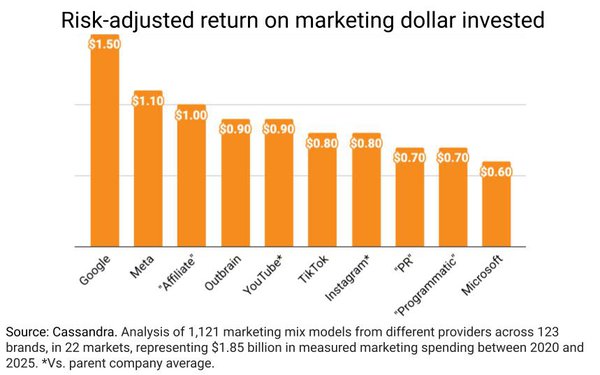
Cassandra's global study analyzed 1,221 marketing mix models (MMMs) across 123 brands, 22 markets, 83 advertising channels, which totaled $1.85 billion in measured marketing spend
between 2020 and 2025. The goal was to help marketers compare channels using risk-adjusted ROI, which balances expected returns with uncertainty for more realistic media planning and budget
allocation, according to the data.
Following the analysis, the company released the findings in its 2026 Media Effectiveness Benchmarks report.
The data showed that the focus is not just
on to what degree a channel returns profit, but how predictable and replicable those returns are over time.
advertisement
advertisement
The study introduced "risk-adjusted ROI," a metric that combines
expected performance with variability, revealing why some high-ROI channels are uncertain, while more mature platforms like Google and Meta continue to dominate budgets because of stable and
reliable outcomes.
While Cassandra uses the term "risk-adjusted ROI" or "returns for advertising measurement," it is a general financial principle that can also apply to stock, bonds, real
estate and more.
Channels with very high median ROI, between 8 times and 9 times higher for each $1 spent, often show wide performance gaps, making them risky without advanced testing and
optimization, while foundation channels like paid search and retail deliver lower but far more predictable returns, according to the company's data.
The best media mix is not always the one
with the highest ROI on paper, according to the report.
Ideally, the media mix should balance return, uncertainty, and an ability to execute campaigns.
Data suggests that brands
prioritizing predictability with limited resources should favor Meta for social and mobile channels and Google for search.
For brands aiming for rapid growth that have the capability of rapid
testing and diversifying into channels like TikTok, programmatic advertising, affiliate advertising and marketing, and Microsoft is recommended.
In many media plans, a combination of Google
and Meta lead for performance and predictability.
This combination makes them strong foundational channels, the report found. They are reliable to grow to reach a wide audience and still
deliver strong ROI.
On average, Google generated $4.40 for every $1.00 spent. This is significantly higher than Meta's average of $2.90 for every $1.00 spent, according to the
report.
Risk adjusting seems to reshapes rankings. While some channels show high median ROI. they decline
significantly after a risk adjustment when outcomes are highly variable. This doesn't automatically mean a channel is "bad." It often means it's more execution-dependent and benefits from stronger
creative testing, measurement discipline, and maturity. Success isn't "guaranteed" by the platform alone. It depends on how well the team manages the campaign and the channels being used.
Cassandra emphases three principles:
Incrementality focuses
on measuring sales directly attributable to advertising rather than total sales.
Diminishing returns highlights each advertising channel has a saturation point where increased spending can
yield smaller returns influenced by seasons and investments.
Testing leverages the agility of digital channels, enabling rapid, cost-effective iteration on targeting and creative elements to
optimize investment performance.
The most important takeaway from this report, the company says, is to manage uncertainty.