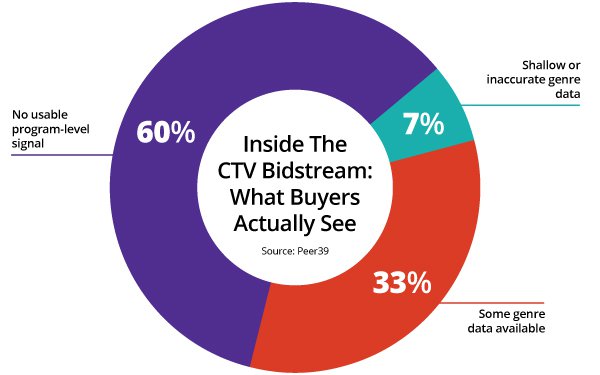
In the open-market connected TV ecosystem, a
substantial number of media-buying programmatic bid requests -- about 60% -- contain little to no program-level content data, according to research from Peer39.
The ad-technology firm, which
specializes in pre-bid targeting/post-buy analysis, says the “majority of impressions available for purchase lack program, and episode level information, genre classifications, quality,
ratings.”
Of the remaining connected TV (CTV) advertising bid requests, around a third contain data that is “shallow or inaccurate.”
Analysis also shows around 25% of
open-exchange CTV total bid requests are classified as “fake content” -- around one in six impressions.
Peer39 adds that 98% of fake CTV comes from mobile app inventory that hides
itself, pretending to be “big-screen inventory.”
advertisement
advertisement
The key to a better deal is not only strong completion rates, but having context. Peer39 says “authenticated content”
-- drama, comedy, action-adventure shows -- offer high levels of completion as well as actual viewership.
When this happens, CTV can be pinned to five core programming areas, accounting for
83% of authenticated delivery. Drama comes in at 25%, with news/information at 18%; comedy, 17%; reality TV, 12%; and action, 11%.
According to Peer39, if a post-buy analysis show says "Pluto
TV" but does not say "Star Trek: Discovery" that is a problem.
“You’re buying a blind aggregation. You cannot distinguish between prime-time content and a background-news clip. If
more than 50% of your delivery lacks program-level signal, your optimization engine is flying blind.”