Artificial intelligence (AI) has moved
from experimental to operational during the past six months -- changing how advertisers plan, buy, create and measure campaigns.
Adoption rates vary by company size, with smaller advertisers
feeling more comfortable moving toward creative optimization.
Larger brands have focused more on inventory discovery and scale, according to the Interactive Advertising Bureau.
The
analysis appears in the first part of its 2026 Digital Video Ad Spend & Strategy Report, titled U.S. Market Size & Growth Projections, released on Tuesday.
The report was fielded
between February 20, 2026 and March 13, 2026 and is based on a 15-minute anonymous online survey and provides insight into the trends in the U.S. TV/video market.
It offers guidance for buyers
and sellers on how they can position and differentiate their strategies based on market opportunities. This year, however, the IAB also examined agentic AI use.
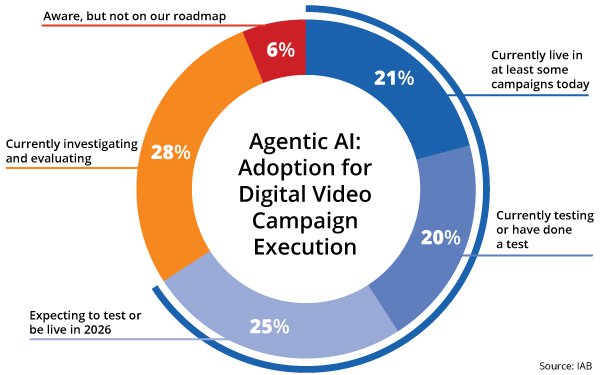
The analysis found that two
in three buyers have live running tests or plan to use agentic AI for digital video campaigns.
advertisement
advertisement
The report notes that when factoring in the additional 28% of companies actively investigating
agentic capabilities, nearly all buyers are already in market or on a path to adopt the technology for digital video campaigns. Use declines as the processes become external-facing.
The report
suggests that human judgment remains critical, considering budgets and spend.
About 51% of those in the industry said they will use agentic for media planning and buying recommendations, while
51% say they will use it for inventory discovery and evaluation and 50% plan to use it for creative testing, selection, or optimization.
Rounding out the top five reasons are media
pre-planning at 45%, and performance analysis and outcome insight at 43%.
Advertisers with small to-mid-sized budgets more often use agentic AI to automate execution-heavy tasks because their
companies, sometimes lacks the infrastructure these tools replicate.
Advertisers with larger budgets focus on inventory discovery and evaluation. Fragmentation across private marketplaces
(PMPs), direct, and open auctions can create complex strategies that are difficult to assess manually.
U.S. digital video ad spend is forecast to surpass $80 billion in 2026 -- double the
volume from only five years ago.
The IAB estimates digital video will grow 11% year-over-year (YoY) in 2026 -- nearly 20% faster than the total ad market. This means digital video for the
first time will exceed 60% of total TV/video spend.
AI innovation is helping to boost social video's 13% growth rate as the creator economy gets more personalized.
Connected TV's
growth rate of 11% is also strong, and is fueled by live and content produced content, according to the report.