WPP Media's just-released mid-year forecast
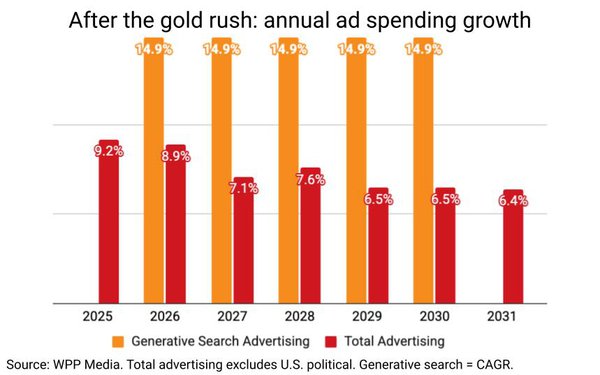
update likens the hyper-acceleration of AI as a "gold rush" financed by the ad industry -- principally the new category of generative search advertising -- which is expected to reach $5.6 billion this
year, $32 billion by 2028 and $100 billion by 2030 for a five-year compound annual growth rate of nearly 100%.
That doesn't explain why total ad spending will actually be decelerating, not
accelerating, over the period.
During the same five-year period, advertising's rate of growth will decline 27% to 6.5% in 2030 from 8.9% in 2026, according to the report (see above).
So I asked the primary author of the report, WPP Media Business Intelligence President Kate Scott-Dawkins, to explain the paradox.
Planning & Buying Insider: If this
truly is a gold rush and it's gong to be a boon for society and make trillions and trillions of dollars and advertising is underwriting it, it doesn't look like the ad industry is getting it back in
return.
advertisement
advertisement
Kate Scott-Dawkins: I do think the fact that we're growing faster than GDP is a thing, right? It is difficult, but not impossible -- as many of the global social
giants have shown -- to grow double-digits off the back of double-digits year-on-year, but it's not easy.
PB&I: But it's not just an irony, it's a paradox, because the ad
industry is the one funding the building of the machine. And the machine is going to benefit others -- to use your gold rush analogy, the people selling picks and shovels -- but they're not
benefitting the ad industry directly.
Scott-Dawkins: I think there are paths where we see over the next few years holdcos better aligned to opportunities for growth within
this new world. One of those is B2B, which is the share of economic activity that is more corporate-to-corporate rather than B2C.
I think agencies are well-placed within that world to provide
services. If you think about the kinds of long-term sales cycles and reputation-building that aren't the things that self-serve platforms are built to do or handle, I think that's one area of growth
for the ad industry.
All these AI endemic companies are springing up and are using self-serve platforms now, because they are direct and they are easy, and they're small scale. What we've seen
in past cycles of that is that as those small self-service platform buyers -- like the Ubers and Airbnbs of the world mature -- they realize that they need a brand and they need to work on that with
consumers, where do they go? They go to agencies.
I think we have that cycle as well, within a year-and-a-half to two years where they will need reputation management and all those things that
will help them build authenticity and authority both for consumers and for the LLMs.
PB&I: So we might be surprised over the next few years by new categories emerging that
re-accelerate advertising growth? We're just not seeing it yet?
Scott-Dawkins: Seven percent [annual ad spending] growth is still really high.
PB&I: No doubt, but it's down from 9% and it's decelerating over the course of your gold rush thesis.